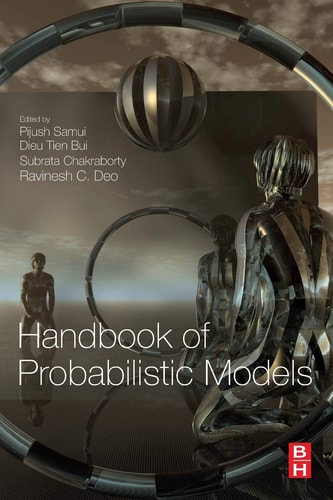
Handbook of Probabilistic Models
0
0
As an Amazon Associate and affiliate partner, Menrva Books earns from qualifying purchases. Learn more
Author Description
Handbook of Probabilistic Models carefully examines the application of advanced probabilistic models in conventional engineering fields. In this comprehensive handbook, practitioners, researchers and scientists will find detailed explanations of technical concepts, applications of the proposed methods, and the respective scientific approaches needed to solve the problem. This book provides an interdisciplinary approach that creates advanced probabilistic models for engineering fields, ranging from conventional fields of mechanical engineering and civil engineering, to electronics, electrical, earth sciences, climate, agriculture, water resource, mathematical sciences and computer sciences. Specific topics covered include minimax probability machine regression, stochastic finite element method, relevance vector machine, logistic regression, Monte Carlo simulations, random matrix, Gaussian process regression, Kalman filter, stochastic optimization, maximum likelihood, Bayesian inference, Bayesian update, kriging, copula-statistical models, and more.
Menrva's Summary
THE THESIS
This handbook investigates the application of advanced probabilistic models across diverse engineering disciplines. It offers practitioners, researchers, and scientists detailed explanations of technical concepts, practical applications of proposed methods, and the scientific approaches required for problem-solving. The book adopts an interdisciplinary perspective, developing advanced probabilistic models for fields such as mechanical and civil engineering, electronics, electrical engineering, earth sciences, climate, agriculture, water resources, mathematics, and computer sciences.
THE SCOPE MAP
- Minimax probability machine regression
- Stochastic finite element method
- Relevance vector machine
- Logistic regression
- Monte Carlo simulations
- Random matrix theory
- Gaussian process regression
- Kalman filter
- Stochastic optimization
- Maximum likelihood estimation
- Bayesian inference and updates
- Kriging
- Copula-statistical models
THE AUTHORITY PERSPECTIVE
The Handbook of Probabilistic Models is structured to provide a comprehensive resource for professionals and academics working with advanced probabilistic techniques in engineering. Its interdisciplinary approach aims to bridge theoretical concepts with practical applications across a wide array of fields, suggesting a focus on utility and breadth of coverage. The detailed inclusion of specific methodologies indicates a text geared towards those seeking in-depth understanding and implementation guidance for complex modeling challenges.
Page Count:
590
Publication Date:
2019-10-08
Publisher:
Elsevier Science
ISBN-10:
0128165146
ISBN-13:
9780128165140
Science
Non-Fiction
Engineering
Machine Learning
Probability
Statistics
Data Science
Computer Science
Community Tags
Similar Books