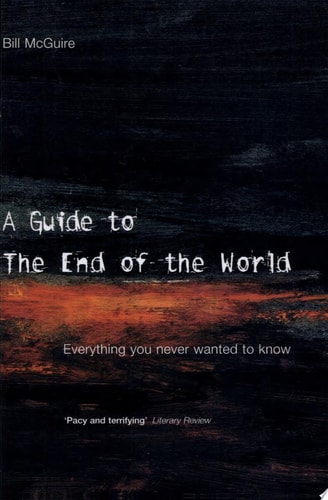
A Guide to the End of the World: Everything You Never Wanted to Know
0
0
As an Amazon Associate and affiliate partner, Menrva Books earns from qualifying purchases. Learn more
Author Description
Thousands of people die every year from floods, volcanic eruptions, earthquakes, hurricanes and typhoons. Yet compared to what the Earth endured in prehistoric times-lethal volcanic winters, deadly asteroid collisions-our civilization has developed against a backdrop of relative geological calm. Will this calm last? A Brief Guide to the End of the World looks at the frightful prospects that await us in the 21st century and beyond.Bill McGuire, a leading expert in the field of geological hazards, admits that the omens are less than encouraging. Only 10,000 years after the last Ice Age, the Earth is sweltering in some of the highest temperatures it has ever seen. Overpopulation and the relentless exploitation of natural resources, combined with rising temperatures and sea levels induced by greenhouse gases, are increasing the likelihood of natural catastrophes, from continuing El Ninos, to large-scale glacial melting, to mega-tsunami. Even more disturbing is the near certainty that we are headed toward another asteroid or comet collision on the scale of the one that wiped out the dinosaurs. In this provocative and immensely readable guidebook, McGuire discusses when these catastrophic events are likely to take place, how they will effect our global society, and what we can do to increase our chances of survival--from emissions reductions, to massive geo-engineering schemes, to the colonization of space.Illustrated with photographs and diagrams, and backed by meticulous research, A Brief Guide to the End of the World sheds new light on the extraordinarily vulnerability of our planet, and on our capacity to withstand the dramatic changes Mother Nature has in store for us in the distant--or not so distant--future.
Menrva's Summary
THE THESIS
This book investigates the susceptibility of modern civilization to catastrophic geological and environmental events by analyzing historical precedents and current planetary trends. Bill McGuire, a professor of geophysical and climate hazards, utilizes his extensive academic background to synthesize data on volcanic activity, asteroid impacts, and climate change. The author argues that humanity currently exists in a period of relative geological stability that is unlikely to persist, necessitating a proactive approach to global risk management and mitigation.
THE SCOPE MAP
What You Will Find
- Analysis of geological hazards including volcanic eruptions, earthquakes, and mega-tsunamis
- Examination of climate-driven risks such as glacial melting and rising sea levels
- Discussion of planetary defense strategies against asteroid and comet collisions
- Evaluation of geo-engineering and space colonization as potential survival mechanisms
Scope Limits
- Does not provide a comprehensive political history of environmental policy
- Does not offer detailed technical blueprints for specific engineering projects
THE AUTHORITY PERSPECTIVE
Experts in the field of geophysics recognize this work as a clear, accessible synthesis of complex planetary risks for a general audience. Readers frequently note that the prose balances scientific rigor with a sobering assessment of human vulnerability to natural phenomena.
Page Count:
191
Publication Date:
2004-09-09
Publisher:
Oxford University Press
ISBN-10:
0192804529
ISBN-13:
9780192804525
Science
End Of The World
Geology
Climatology
Community Tags
Similar Books