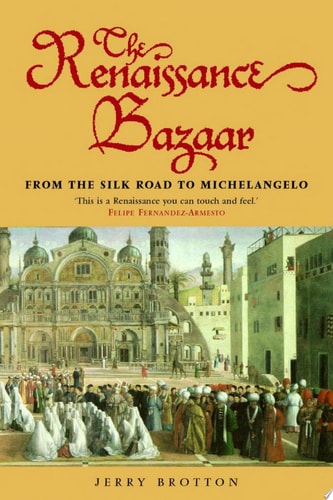
The Renaissance Bazaar: From the Silk Road to Michelangelo
0
0
As an Amazon Associate and affiliate partner, Menrva Books earns from qualifying purchases. Learn more
Author Description
The Renaissance range in changes at a breathtaking pace, changes that shape the world to this day. Now Jerry Brotton deftly captures this remarkable age, in a book that places Europe's great flowering in a revealing global context.It was Europe's contact with the outside world, Brotton argues, especially with the rich and cultivated East, that made the Renaissance what it was. Indeed, Europeans saw themselves through the mirror of the East--it was during this age, for instance, that they first spoke of themselves as "Europeans." Here is cultural history of the best kind, as Brotton muses on the meanings of Holbein's painting "The Ambassadors"--which is virtually a catalog of the international influences on Europe--or on the Arabic influence in the burgeoning sciences of astronomy and geography. This global approach offers revealing new insights into such men as Dante and Leonardo da Vinci and highlights the international influences behind Chaucer's Canterbury Tales. Along with fresh and original discussions of well-known figures from Copernicus to Dürer to Shakespeare, Brotton offers a far-reaching exploration that looks at paintings and technology, patterns of trade and the printed page, as he illuminates the overarching themes that defined the age.From architecture to medicine, from humorists to explorers, the teeming world of the Renaissance comes to life in this thoughtful, insightful, and beautifully written book, which offers us a timely perspective on the Renaissance as a moment of global inclusiveness that still has much to teach us today.
Menrva's Summary
THE THESIS
This book investigates the extent to which the European Renaissance was fundamentally shaped by sustained contact and exchange with the non-European world, particularly the East. Jerry Brotton, a professor of Renaissance studies, utilizes a wide array of primary sources, including art, cartography, and literature, to argue that the period was not an isolated European phenomenon but a product of global interconnectedness. He posits that the identity of 'Europe' emerged largely through its interactions with Islamic and Asian cultures, challenging traditional Eurocentric narratives of the era.
THE SCOPE MAP
What You Will Find
- Analysis of cross-cultural influences on Renaissance art, such as Holbein's 'The Ambassadors'
- Examination of Arabic contributions to astronomy, geography, and scientific thought
- Discussion of international trade patterns and their impact on European literature and technology
- Re-evaluations of figures including Dante, Leonardo da Vinci, Chaucer, Copernicus, and Shakespeare
Scope Limits
- The text does not provide an exhaustive political history of every European nation-state during the period.
- It focuses primarily on cultural and intellectual exchange rather than military or purely economic history.
THE AUTHORITY PERSPECTIVE
Scholars and critics frequently note the book's success in reorienting the Renaissance within a broader global framework. Readers often highlight the accessible prose style, which makes complex historical and art-historical arguments clear for a general audience.
Page Count:
264
Publication Date:
2003-12-18
Publisher:
Oxford University Press
ISBN-10:
0192802658
ISBN-13:
9780192802651
History
Cultural History
Global Studies
History of the Americas
Renaissance
Art History
World history
Community Tags
Similar Books