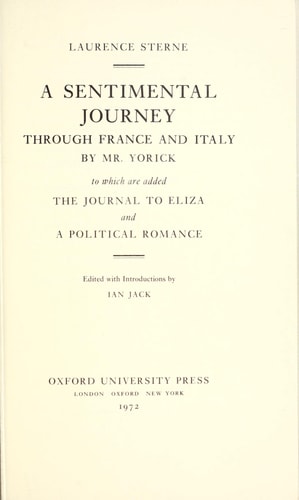
A Sentimental Journey Through France and Italy
0
0
As an Amazon Associate and affiliate partner, Menrva Books earns from qualifying purchases. Learn more
Author Description
'I have laid a plan for something new, quite out of the beaten track.' The result, "A Sentimental Journey," is as far from the conventional travel-book as "Tristram Shandy" differs from other novels. It is fiction rather than reportage, and may well be regarded as yet another offshoot from that picaresque stock which bore such varied fruit throughout the seventeenth and eighteenth centuries. Although Sterne set out with the conscious aim of exploiting his gift for pathos, the outcome of his work has nothing in common with the study in "The Pathetic," enlivened only by 'the innocently humorous', called for by one of his moralizing critics. A less innocent book has never been written.
Menrva's Summary
THE PULSE
The narrator, Yorick, embarks on a tour through France and Italy, prioritizing emotional encounters and subjective impressions over the traditional objective observations of travel writing. Yorick navigates a series of episodic interactions, seeking to document the nuances of human sentiment and social performance. His objective is to experience the world through a lens of refined sensibility, often finding himself in situations that test his wit and moral resolve. The narrative framework is highly subjective and digressive, reflecting the internal state of the protagonist rather than a linear account of geographical progress.
INSIDE THE PAGES
- Episodic narrative structure
- First-person stream of consciousness
- Satirical commentary on travel conventions
- Focus on sentimentalism and emotional response
- Philosophical digressions
- Irony-laden character interactions
- Playful and experimental prose style
- Meta-fictional reflections on the act of writing
THE COLLECTIVE ECHO
Readers and critics frequently identify this work as a departure from the rigid travelogues common to the eighteenth century. Discussion often centers on the distinction between the narrator's stated intent to record sentiment and the underlying irony that permeates his encounters. Many highlight the stylistic similarities to the author's other major works, noting the same penchant for digression and unconventional pacing. The text is often analyzed for its subversion of the picaresque tradition, as it prioritizes internal psychological states over external physical movement. Scholars emphasize that the work remains a foundational example of how fiction can masquerade as reportage to explore the complexities of human character.
Page Count:
268
Publication Date:
1972-04-27
Publisher:
Oxford University Press
ISBN-10:
0192811339
ISBN-13:
9780192811332
Travel
Fiction
Satire
18th century
Manners and customs
classic
Community Tags
Other Editions(10)

Independently Published
2021
Default edition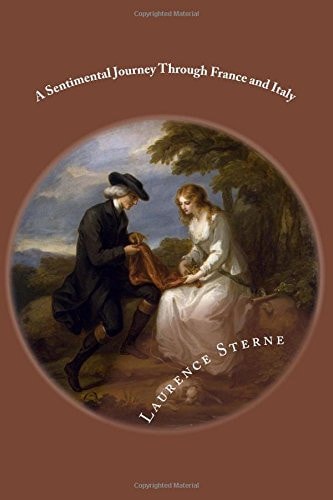
CreateSpace Independent Publishing Platform
2017

CreateSpace Independent Publishing Platform
2014

CreateSpace Independent Publishing Platform
2014

Classic Books
2013

Kessinger Publishing
2004

Dover Publications
2004

Classic Books
2001
Oxford University Press
1972
Oxford University Press
1968
Similar Books





Reader Comments
Share Your Thoughts
No comments yet. Be the first to share your thoughts!