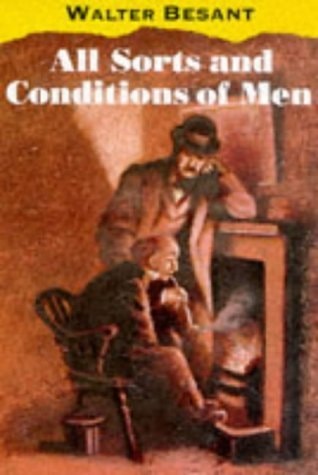
All Sorts and Conditions of Men
0
0
As an Amazon Associate and affiliate partner, Menrva Books earns from qualifying purchases. Learn more
Author Description
In All Sorts and Conditions of Men (1882) Besant vividly portrays the poverty and deprivation of London's East End in a story about transformations and crossings of class-boundaries.Simultaneously a `condition of England' novel, New Woman fiction, romance, comedy, satire and crime story, All Sorts and Conditions of Men has strong roots in the politics of nineteenth-century reform. Determined to use her inherited wealth benevolently, Angela Messenger, a young idealistic Cambridge graduate, changes her name and takes lodgings in a Stepney boarding-house to observe and gain understanding of the East End. Young aristocrat Harry Le Breton also haunts the area, discovering his origins, and a new sense of kinship. Consistently setting itself against the cheerless evangelical strain in Victorian philanthropy, All Sorts and Conditions of Men offers a blueprint for the cultural regeneration of Britain's proletariat as Angela and Harry plan a `Palace of Delight' to provide `a little more of the pleasures and graces of life' for the East Enders they have come to know. Indeed, five years after the book's publication, Besant's `generous and glowing imagination' was praised as the inspiration for the real-life `The People's Palace' on the Mile End Road, and All Sorts and Conditions of Men became that rare thing, a work of fiction which made something happen.
Menrva's Summary
THE PULSE
An idealistic heiress disguises her identity to infiltrate the impoverished East End of London, seeking to bridge the divide between social classes through benevolent reform. Angela Messenger abandons her privileged life as a Cambridge graduate to reside in a Stepney boarding-house, where she encounters Harry Le Breton, a man searching for his own origins. Together, they navigate the rigid social hierarchies of the nineteenth century, attempting to implement a vision for cultural regeneration. The narrative framework employs a blend of social realism and romantic idealism to examine the potential for individual agency in addressing systemic urban inequality.
INSIDE THE PAGES
- Exploration of Victorian class boundaries and social stratification
- Critique of contemporary philanthropic methods
- Integration of romantic and comedic subplots
- Focus on urban poverty in London's East End
- Satirical commentary on aristocratic detachment
- Development of the 'Palace of Delight' as a central narrative device
- Portrayal of the 'New Woman' archetype
- Examination of the intersection between inherited wealth and social responsibility
THE COLLECTIVE ECHO
Discussion often centers on the novel's unique position as a work of fiction that directly influenced real-world urban planning and social reform. Readers frequently highlight the contrast between Besant's optimistic vision for the proletariat and the grim reality of the Victorian East End. Critics often examine the balance between the book's didactic reformist goals and its function as a piece of popular entertainment. The text is noted for its ability to blend various genres, including satire and romance, to maintain engagement while presenting a specific political argument. Many readers find the historical context regarding the 'People's Palace' essential to understanding the author's intent and the book's lasting cultural impact.
Page Count:
436
Publication Date:
1997-12-11
Publisher:
Oxford University Press
ISBN-10:
0192832581
ISBN-13:
9780192832580
Romance
Historical Fiction
Satire
Social Reform
Victorian
London England
Classic Literature
England
Community Tags
Other Editions(5)



Similar Books






Reader Comments
Share Your Thoughts
No comments yet. Be the first to share your thoughts!