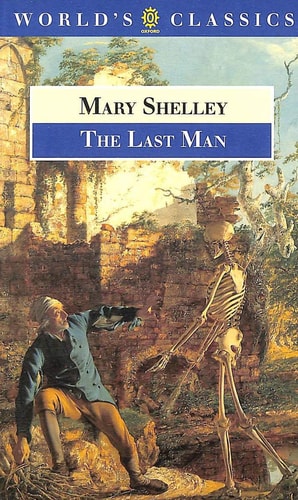
The Last Man
0
0
As an Amazon Associate and affiliate partner, Menrva Books earns from qualifying purchases. Learn more
Author Description
The Last Man ends in 2100, "the last year of the world." A devastating plague has wiped out humanity, except for one man. This novel of horror, originally published in 1826, was rejected in its time and out of print from 1833 to 1963, when the first Bison Books edition appeared. Some critics now rate The Last Man more highly than Frankenstein, by the same author. This Bison Books edition offers a new introduction by Anne K. Mellor, who writes, "In our era of AIDS and biological warfare, Shelley's apocalyptic vision of an incurable plague that gradually destroys the entire human species resonates with mythic power."
Menrva's Summary
THE PULSE
A global pandemic systematically eradicates the human population, leaving Lionel Verney as the sole survivor in a desolate world. Verney, the protagonist, navigates the collapse of civilization as society crumbles under the weight of an unstoppable plague. He faces the logical constraints of a world where infrastructure, social order, and hope vanish, leaving him to confront the silence of a vacant planet. The narrative framework utilizes a retrospective, first-person perspective that emphasizes the isolation and psychological toll of being the final witness to humanity's extinction. Verney must contend with the physical decay of his surroundings and the internal struggle to maintain his sanity amidst total solitude.
INSIDE THE PAGES
- First-person retrospective narration
- Apocalyptic setting in the 21st century
- Exploration of political and social collapse
- Philosophical inquiry into human existence
- Gothic atmospheric elements
- Focus on the psychological impact of isolation
- Themes of mortality and the fragility of civilization
- Non-linear reflection on past societal structures
THE COLLECTIVE ECHO
Readers frequently highlight the stark contrast between the novel's intimate character studies and its grand, apocalyptic scale. Discussion often centers on the author's ability to project 19th-century anxieties onto a futuristic landscape, creating a sense of dread that remains relevant to modern audiences. Critics often note the pacing is deliberate, favoring philosophical reflection over rapid-fire action sequences. Many readers appreciate the bleak, atmospheric world-building that defines the protagonist's final years. The work is often compared to the author's other major contributions, with many arguing that its thematic depth regarding human extinction is particularly profound.
Page Count:
507
Publication Date:
1994-01-01
Publisher:
Oxford University Press
ISBN-10:
0192831526
ISBN-13:
9780192831521
Dystopian
Science Fiction
Post-Apocalyptic
End Of The World
Twenty-first Century
Gothic
Classic Literature
Plague
Community Tags
Similar Books