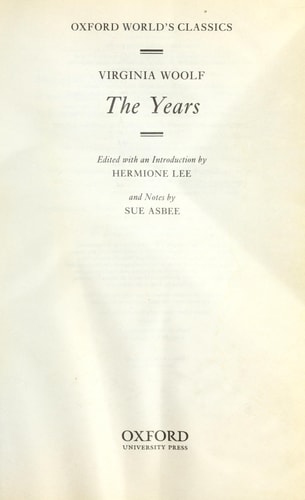
The Years
0
0
As an Amazon Associate and affiliate partner, Menrva Books earns from qualifying purchases. Learn more
Author Description
As the Pargiters, a middle-class English family, move from the oppressive confines of the Victorian home of the 1880s to the `present day' of the 1930s, they are weighed down by the pressures of war, the social strictures of patriarchy, capitalism and Empire, and the rise of Fascism. Engaging with a painful struggle between utopian hopefulness and crippled with despair, the novel is a savage indictment of Virginia Woolf's society, but its bitter sadness is relieved by the longing for some better way of life, where `freedom and justice' might really be possible. This is Virginia Woolf's longest novel, and the one she found the most difficult to write. The most popular of all her writings during her lifetime, it can now be re-read as the most challengingly political, even revolutionary, of all her books.
Menrva's Summary
THE PULSE
The Pargiter family navigates the shifting social and political landscape of England across five decades, from the rigid Victorian era to the uncertainty of the 1930s. As the family members age, they confront the constraints of patriarchy, the looming threat of war, and the decline of the British Empire. The narrative follows the Pargiters through various domestic and public settings, documenting their internal conflicts and their reactions to a rapidly changing world. Woolf employs a non-linear, impressionistic framework that prioritizes the passage of time and the accumulation of small, seemingly mundane moments over traditional plot progression. The characters struggle to reconcile their personal desires for freedom and justice with the oppressive structures of their society.
INSIDE THE PAGES
- Non-linear chronological structure spanning 1880 to the 1930s
- Impressionistic prose focusing on internal consciousness
- Multi-generational family saga format
- Critique of Victorian social norms and patriarchal authority
- Exploration of the impact of war and Fascism on private life
- Emphasis on the passage of time and the fluidity of memory
- Shift in narrative focus between various family members
- Philosophical inquiry into the possibility of social justice
THE COLLECTIVE ECHO
Readers and critics often note the stylistic departure this work takes from Woolf's more experimental stream-of-consciousness novels, highlighting its more grounded, realistic approach to character interaction. Discussion frequently centers on the novel's political weight and its unflinching examination of the decline of the British middle class. Many readers find the pacing deliberate and meditative, reflecting the slow erosion of social traditions over several decades. Scholars often emphasize the book's role as a bridge between Woolf's earlier aesthetic concerns and her later, more overtly political writings. The text remains a subject of debate regarding its effectiveness in balancing personal character arcs with the broader, sweeping historical changes it depicts.
Page Count:
524
Publication Date:
1999-01-01
Publisher:
Oxford University Press España, S.A.
ISBN-10:
0192836625
ISBN-13:
9780192836625
Literary
Contemporary
classic
Family Saga
Modernist
Historical
Community Tags
Similar Books