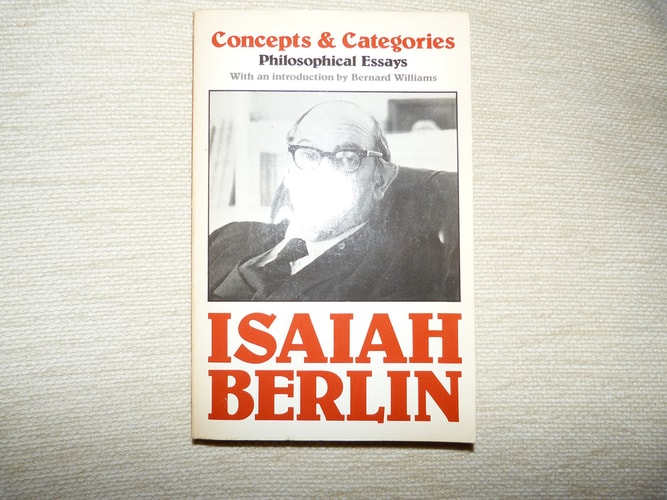
Concepts and Categories: Philosophical Essays
0
0
As an Amazon Associate and affiliate partner, Menrva Books earns from qualifying purchases. Learn more
Author Description
This collection of eight essays spans the range of Isaiah Berlin's interests, including his role in the disputes of language philosophers in the 1930s, his interest in political philosophy, and his later attention to the history of ideas. In Berlin's preface, he records his decision to abandon philosophy for history in the 1940s, but by his own definition of philosophy, given in the first essay ("The Purpose of Philosophy"), he continued to be a philosopher par excellence, radically questioning the models, or categories, by which human beings understand their world. Berlin sees this as the perennial task of the philosopher (which he recognizes as "agonizing and thankless") and one he takes up in this collection with analyses in chapters such as "Verification" and "Equality." It is doubtful now whether Berlin's view of philosophy would be taken as an exhaustive account of the enterprise, especially with the flourishing in the last 25 years of applied ethics and political philosophy. And it seems reasonable to suppose that philosophy will continue to involve speculative work about the proper ends of human life, as well as logical analysis. Berlin's paradoxical contribution, evident in this collection, was that in committing himself to a life of radical questioning of concepts and categories, he in fact proposed a purpose for life, namely the creation of a society that would not be duped by incoherent and idealistic models of the world. Radical philosophical questioning, that drive for clarity in language and for models of the world that are capable of empirical testing, is not in such circumstances the Sisyphean endeavor it might otherwise appear. --Jeff Petts, Amazon.co.uk
Menrva's Summary
THE THESIS
This collection investigates the core purpose of philosophy as a tool for critically examining the conceptual frameworks and categories through which humans interpret their existence. Isaiah Berlin, a prominent philosopher and historian of ideas, presents a series of essays that bridge his early work in linguistic philosophy with his later focus on political theory and historical analysis. By reflecting on his own transition from pure philosophy to the history of ideas, Berlin argues that the philosopher's primary duty is to challenge the incoherent models that shape societal understanding.
THE SCOPE MAP
What You Will Find
- Analysis of linguistic disputes from the 1930s
- Philosophical inquiries into the nature of equality and verification
- Reflections on the methodology of historical study versus speculative philosophy
- A preface detailing the author's intellectual evolution
Scope Limits
- The text does not provide a comprehensive overview of contemporary applied ethics
- The collection is limited to Berlin's specific intellectual interests and does not cover the full breadth of 20th-century analytic philosophy
THE AUTHORITY PERSPECTIVE
Experts recognize this collection as a significant window into Berlin's intellectual development and his unique approach to conceptual analysis. Readers frequently note the academic density of the prose, which serves as a foundational text for those interested in the intersection of political theory and the history of ideas.
Page Count:
224
Publication Date:
1980-10-16
Publisher:
Oxford University Press
ISBN-10:
0192830279
ISBN-13:
9780192830272
Philosophy
Essays
Political Philosophy
History of Ideas
New Used & Rental Textbooks
Community Tags
Similar Books