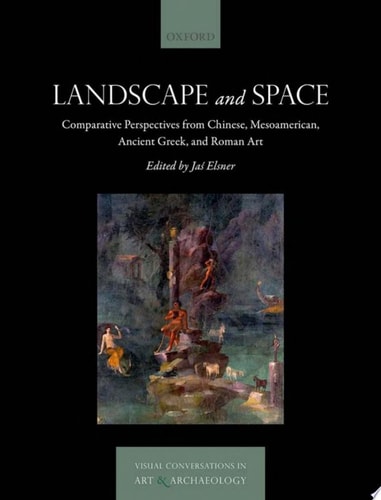
Landscape and Space: Comparative Perspectives from Chinese, Mesoamerican, Ancient Greek, and Roman Art
0
0
As an Amazon Associate and affiliate partner, Menrva Books earns from qualifying purchases. Learn more
Author Description
Landscape has been a key theme in world archaeology and trans-cultural art history over the last half century, particularly in the study of painting in art history and in all questions of human intervention and the placement of monuments in the natural world within archaeology. However, the representation of landscape has been rather less addressed in the scholarship of the archaeologically-accessed visual cultures of the ancient world. The kinds of reliefs, objects, and paintings discussed here have a significant purchase on matters concerned with landscape and space in the visual sphere, but were discovered within archaeological contexts and by means of excavation. Through case studies focused on the invention of wilderness imagery in ancient China, the relation of monuments to landscape in ancient Greece, the place of landscape painting in Mesoamerican Maya art, and the construction of sacred landscape across Eurasia between Stonehenge and the Silk Road via Pompeii, this book emphasises the importance of thinking about models of landscape in ancient art, as well as the value of comparative approaches in underlining core aspects of the topic. Notably, it explores questions of space, both actual and conceptual, including how space is configured through form and representation.
Menrva's Summary
THE THESIS
How do ancient visual cultures across disparate civilizations configure, represent, and conceptualize the relationship between human intervention and the natural landscape? Jaś Elsner, a prominent scholar in art history and classical archaeology, synthesizes cross-cultural evidence to argue that landscape is not merely a backdrop but a constructed space of ideological and sacred significance. By examining archaeological artifacts alongside artistic representations, the text establishes a framework for comparing how ancient societies from China to Mesoamerica integrated monuments into their physical environments.
THE SCOPE MAP
What You Will Find
- Comparative analysis of wilderness imagery in ancient China and landscape painting in Maya art.
- Examination of the spatial configuration of monuments in ancient Greece and Roman Pompeii.
- Theoretical exploration of sacred landscapes spanning from Stonehenge to the Silk Road.
Scope Limits
- The text focuses primarily on archaeologically-accessed visual cultures rather than literary or philosophical descriptions of nature.
- It does not provide an exhaustive survey of all ancient landscape traditions, concentrating instead on specific case studies of relief, painting, and object placement.
THE AUTHORITY PERSPECTIVE
Scholars and students of art history frequently cite this work as a significant contribution to the comparative study of ancient visual culture. Experts highlight the text for its ability to bridge the gap between archaeological excavation data and art historical interpretation of spatial representation.
Page Count:
208
Publication Date:
2022-03-22
Publisher:
Oxford University Press
ISBN-10:
0192845950
ISBN-13:
9780192845955
Archaeology
Art History
Visual Culture
Comparative Studies
Ancient History
Community Tags
Similar Books