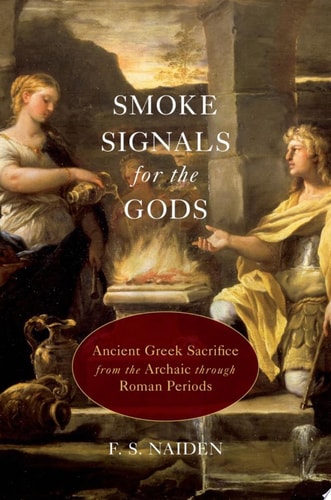
Smoke Signals for the Gods: Ancient Greek Sacrifice from the Archaic through Roman Periods
0
0
As an Amazon Associate and affiliate partner, Menrva Books earns from qualifying purchases. Learn more
Author Description
Animal sacrifice has been critical to the study of ancient Mediterranean religions since the nineteenth century. Recently, two theories have dominated the subject of sacrifice: the psychological and ethological approach of Walter Burkert and the sociological and cultural approach of Jean-Pierre Vernant and Marcel Detienne. These writers have argued that sacrifice allays feelings of guilt at the slaughter of sacrificial animals and that it promotes solidarity. None of them leaves much room for the role of priests or gods, or compares animal sacrifice to other oblations offered to the gods. F. S. Naiden redresses the omission of these features to show that, far from being an attempt to assuage guilt or foster solidarity, animal sacrifice is an attempt to make contact with a divine being, and that it is so important-and perceived to be so risky-for the worshippers that it becomes subject to regulations of unequaled extent and complexity. Smoke Signals for the Gods addresses these regulations as well as literary texts, while drawing on recent archaeological work on faunal remains. It also seeks to explain how mistaken views of sacrifice arose, and traces them as far back as early Christianity. This many-sided study provides a new picture of ancient Greek animal sacrifice and of the religion of which sacrifice was a part.
Menrva's Summary
THE THESIS
This book investigates the primary function of animal sacrifice in ancient Greek religion, challenging the long-standing sociological and psychological theories that prioritize human guilt or social solidarity over divine interaction. F. S. Naiden, a scholar of ancient history, utilizes a combination of literary analysis, archaeological faunal data, and historical regulation records to argue that sacrifice was a highly regulated, risky, and intentional method of establishing direct contact with the divine. By re-examining the role of priests and the specific nature of oblations, the author provides a framework that shifts the focus from the internal state of the worshipper to the external mechanics of religious communication.
THE SCOPE MAP
What You Will Find
- Analysis of religious regulations governing sacrificial procedures from the Archaic through Roman periods.
- Comparative study of animal sacrifice versus other forms of divine oblation.
- Integration of recent archaeological findings regarding faunal remains at ritual sites.
- Historical critique of how early Christian interpretations influenced modern academic misconceptions of Greek ritual.
Scope Limits
- The text does not provide a comprehensive history of all Greek religious festivals.
- It does not focus on the private or domestic religious practices of non-elite citizens.
THE AUTHORITY PERSPECTIVE
Scholars and students of classical religion recognize this work as a significant intervention in the study of ritual practice, noting its departure from the established Burkert and Vernant paradigms. Readers frequently highlight the academic density of the prose and the author's meticulous attention to the legalistic complexities of ancient sacrificial codes.
Page Count:
442
Publication Date:
2015-03-01
Publisher:
Oxford University Press
ISBN-10:
0190232714
ISBN-13:
9780190232719
History
Religion
Archaeology
Sacrifice
Rome religion
Greece
Ancient History
Greek Mythology
Community Tags
Other Editions(2)

Similar Books