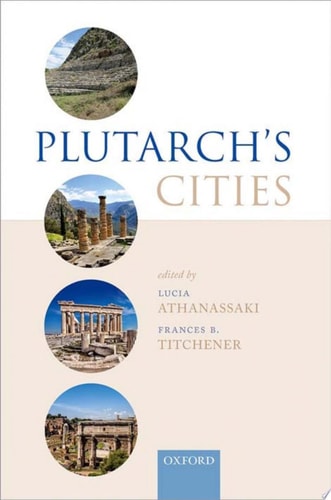
Plutarch's Cities
0
0
As an Amazon Associate and affiliate partner, Menrva Books earns from qualifying purchases. Learn more
Author Description
Plutarch's Cities is the first comprehensive attempt to assess the significance of the polis in Plutarch's works from several perspectives, namely the polis as a physical entity, a lived experience, and a source of inspiration, the polis as a historical and sociopolitical unit, the polis as a theoretical construct and paradigm to think with. The book's multifocal and multi-perspectival examination of Plutarch's cities - past and present, real and ideal-yields some remarkable corrections of his conventional image. Plutarch was neither an antiquarian nor a philosopher of the desk. He was not oblivious to his surroundings but had a keen interest in painting, sculpture, monuments, and inscriptions, about which he acquired impressive knowledge in order to help him understand and reconstruct the past. Cult and ritual proved equally fertile for Plutarch's visual imagination. Whereas historiography was the backbone of his reconstruction of the past and evaluation of the present, material culture, cult, and ritual were also sources of inspiration to enliven past and present alike. Plato's descriptions of Athenian houses and the Attic landscape were also a source of inspiration, but Plutarch clearly did his own research, based on autopsy and on oral and written sources. Plutarch, Plato's disciple and Apollo's priest, was on balance a pragmatist. He did not resist the temptation to contemplate the ideal city, but he wrote much more about real cities, as he experienced or imagined them.
Menrva's Summary
THE THESIS
This volume investigates the significance of the polis within Plutarch's body of work, challenging the traditional view of him as a detached antiquarian. The authors, Frances B. Titchener and Lucia Athanassaki, utilize a multi-perspectival approach to analyze how Plutarch engaged with the city as a physical, historical, and theoretical entity. By examining his integration of material culture, ritual, and historiography, the text argues that Plutarch was a pragmatist deeply connected to the lived experience of his environment.
THE SCOPE MAP
What You Will Find
- Analysis of the polis as a physical entity and lived experience
- Examination of Plutarch's use of material culture, including sculpture and monuments
- Discussion of the influence of Platonic thought on Plutarch's urban descriptions
- Evaluation of Plutarch's methodology regarding oral and written sources
Scope Limits
- Does not provide a general biography of Plutarch's life
- Does not cover the entirety of Plutarch's political philosophy outside the context of the city
THE AUTHORITY PERSPECTIVE
Scholars recognize this work as a significant contribution to Plutarchan studies for its focus on his engagement with material culture and urban reality. The text is considered an important resource for those interested in the intersection of ancient history, archaeology, and classical philosophy.
Page Count:
368
Publication Date:
2022-10-03
Publisher:
Oxford University Press
ISBN-10:
0192859919
ISBN-13:
9780192859914
Philosophy
History
Biography
Ancient Greece
Urban Studies