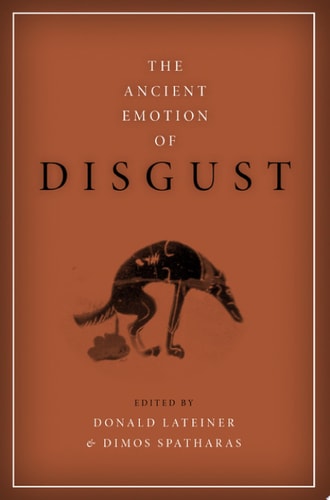
The Ancient Emotion of Disgust
0
0
As an Amazon Associate and affiliate partner, Menrva Books earns from qualifying purchases. Learn more
Author Description
The study of emotions and emotional displays has achieved a deserved prominence in recent classical scholarship. The emotions of the classical world can be plumbed to provide a valuable heuristic tool. Emotions can help us understand key issues of ancient ethics, ideological assumptions, and normative behaviors, but, more frequently than not, classical scholars have turned their attention to "social emotions" requiring practical decisions and ethical judgments in public and private gatherings. The emotion of disgust has been unwarrantedly neglected, even though it figures saliently in many literary genres, such as iambic poetry and comedy, historiography, and even tragedy and philosophy. This collection of seventeen essays by fifteen authors features the emotion of disgust as one cutting edge of the study of Greek and Roman antiquity. Individual contributions explore a wide range of topics. These include the semantics of the emotion both in Greek and Latin literature, its social uses as a means of marginalizing individuals or groups of individuals, such as politicians judged deviant or witches, its role in determining aesthetic judgments, and its potentialities as an elicitor of aesthetic pleasure. The papers also discuss the vocabulary and uses of disgust in life (Galli, actors, witches, homosexuals) and in many literary genres: ancient theater, oratory, satire, poetry, medicine, historiography, Hellenistic didactic and fable, and the Roman novel. The Introduction addresses key methodological issues concerning the nature of the emotion, its cognitive structure, and modern approaches to it. It also outlines the differences between ancient and modern disgust and emphasizes the appropriateness of "projective or second-level disgust" (vilification) as a means of marginalizing unwanted types of behavior and stigmatizing morally condemnable categories of individuals. The volume is addressed first to scholars who work in the field of classics, but, since texts involving disgust are central to the study of ancient culture, it will also appeal to those interested in the history of emotions and the history of ideas.
Menrva's Summary
THE THESIS
This collection of essays investigates the neglected role of disgust as a critical heuristic tool for understanding the ethical, social, and ideological frameworks of Greek and Roman antiquity. Editors Dimos Spatharas and Donald Lateiner compile seventeen contributions from fifteen scholars to analyze how this specific emotion functioned as a mechanism for marginalization, aesthetic judgment, and moral stigmatization within ancient societies. By examining the semantics and cognitive structures of disgust, the authors provide a framework for distinguishing between ancient and modern emotional expressions.
THE SCOPE MAP
What You Will Find
- Analysis of disgust in iambic poetry, comedy, tragedy, historiography, and medicine.
- Examination of social marginalization targeting politicians, witches, and other deviant groups.
- Methodological discussion on the cognitive structure of disgust and its role in aesthetic pleasure.
Scope Limits
- The volume focuses primarily on Greek and Roman antiquity and does not provide a comprehensive cross-cultural history of disgust.
- It does not offer a clinical psychological manual but rather a philological and historical analysis of literary and social texts.
THE AUTHORITY PERSPECTIVE
Scholars in the field of classics recognize this volume as a significant contribution to the study of ancient emotional history. Readers frequently note the academic density of the prose, which is tailored specifically for researchers and students of classical literature and history.
Page Count:
336
Publication Date:
2016-01-01
Publisher:
Oxford University Press
ISBN-10:
0190630825
ISBN-13:
9780190630829
Philosophy
Psychology
History
Ancient - Rome
Ancient Greece
Ancient History
Literary Criticism
Community Tags
Similar Books



Reader Comments
Share Your Thoughts
No comments yet. Be the first to share your thoughts!