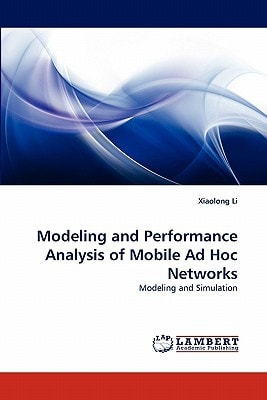
Modeling and Performance Analysis of Mobile Ad Hoc Networks
0
0
As an Amazon Associate and affiliate partner, Menrva Books earns from qualifying purchases. Learn more
Author Description
Ad hoc networks are gaining increasing popularity in recent years because of their ease of deployment. In ad hoc networks, Medium Access Control (MAC) protocols are a fundamental element that determines the efficiency in sharing the limited communication bandwidth. IEEE 802.11 distributed coordination function (DCF) is the most widely used MAC protocol in ad hoc networks due to its compatibility with the IEEE 802 protocol suite. Since the release of the IEEE 802.11 specification, many research efforts have been devoted to modeling the performance of this protocol. However, most of studies are confined to the stationary performance with ideal channel. This book aims to release these assumptions and find the impact of mobility and time varying channel on the DCF performance.
Menrva's Summary
THE THESIS
This book investigates the performance of Mobile Ad Hoc Networks (MANETs) by analyzing the impact of mobility and time-varying channels on the IEEE 802.11 Distributed Coordination Function (DCF) MAC protocol. The author, Xiaolong Li, addresses the limitations of previous studies that often assumed stationary conditions and ideal channels. By releasing these assumptions, the book aims to provide a more realistic understanding of how factors like node movement and fluctuating signal quality affect the efficiency of bandwidth sharing in MANETs. The research presented focuses on the fundamental challenges of MAC protocol design in dynamic wireless environments.
THE SCOPE MAP
- Detailed analysis of the IEEE 802.11 Distributed Coordination Function (DCF) MAC protocol.
- Examination of the impact of node mobility on DCF performance.
- Investigation into the effects of time-varying channel conditions on MAC protocol efficiency.
- Modeling techniques for simulating and analyzing MANET performance under dynamic conditions.
- Comparison of stationary versus mobile performance metrics for ad hoc networks.
- Discussion of bandwidth sharing efficiency in the context of limited communication resources.
- Identification of key challenges in designing MAC protocols for dynamic wireless environments.
THE AUTHORITY PERSPECTIVE
The book provides a focused analysis on the performance of Mobile Ad Hoc Networks, specifically addressing the IEEE 802.11 DCF protocol under realistic conditions of mobility and channel variation. It aims to fill a gap in existing research by moving beyond stationary assumptions. The work is likely to be of interest to researchers and practitioners in wireless networking who need to understand the practical limitations and performance characteristics of ad hoc networks in dynamic environments. The detailed modeling and analysis presented offer insights into optimizing network efficiency.
Page Count:
120
Publication Date:
2010-01-01
Publisher:
Lap Lambert Academic Publishing GmbH KG
ISBN-10:
3843387591
ISBN-13:
9783843387590
Science & Technology
Non-Fiction
Networking
Computer Science
Community Tags
Similar Books