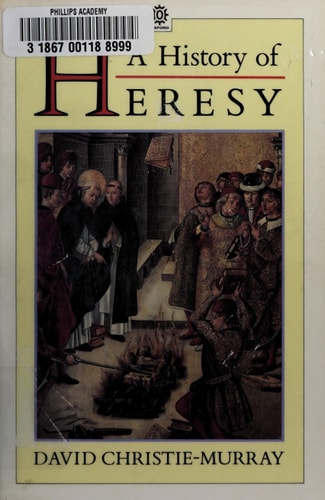
A History of Heresy
0
0
As an Amazon Associate and affiliate partner, Menrva Books earns from qualifying purchases. Learn more
Author Description
With the changes in Christian orthodoxy over the centuries, the term heretic has come to hold a wide range of meanings. Society condemned the first Christians, themselves, as heretics because they defied the doctrines of Judaism. Focusing specifically on Christian heresy, David Christie-Murray's cogent and lucid study surveys minority believers from the early Judaizers, who believed that salvation depended purely on the observation of Christian versions of "the law," through Gnosticism, Montanism, Monarchianism, Arianism, Apollinarianism, Nestorianism, Pelagianism, Lutheranism, Anglicanism, and other movements and minorities, to the bewildering variety of heresies in the twentieth century.Based on extensive scholarship, and yet compulsively readable, Christie-Murray's book explains the differences between different shades of Christian thought, and also provides an exciting, continuous narrative of the development of Christianity through the ages.
Menrva's Summary
THE THESIS
This work investigates the evolution of the term 'heretic' and the historical development of Christian orthodoxy through the lens of minority belief systems. David Christie-Murray utilizes his background in theological scholarship to trace the shifting boundaries of acceptable doctrine from the early church to the twentieth century. The text argues that the definition of heresy is fluid, often reflecting the political and social pressures of the era in which the dissent occurred.
THE SCOPE MAP
What You Will Find
- A chronological survey of Christian movements including Gnosticism, Arianism, and Pelagianism.
- Analysis of the transition from early Judaizers to modern denominational variations.
- Examination of the socio-political context surrounding the condemnation of minority beliefs.
Scope Limits
- The text focuses exclusively on Christian heresy and does not address non-Christian religious dissent.
- The analysis prioritizes historical and theological development over deep philosophical deconstruction of individual dogmas.
THE AUTHORITY PERSPECTIVE
Experts and readers frequently cite this work as a highly accessible and comprehensive introduction to the complex history of Christian dissent. The prose is noted for its clarity, making dense theological conflicts understandable for those without a specialized academic background.
Page Count:
256
Publication Date:
1989-10-19
Publisher:
Oxford University Press
ISBN-10:
0192852108
ISBN-13:
9780192852106
Religion
History
Theology
Christianity
Heresy
Church History
Community Tags
Similar Books