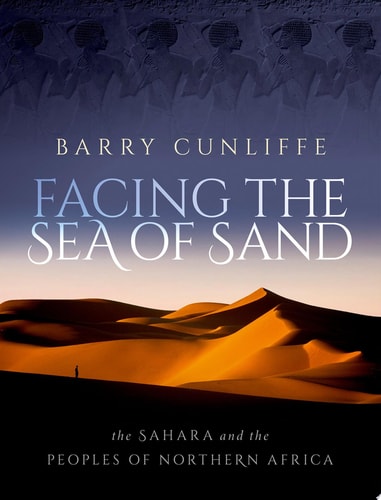
Facing the Sea of Sand: The Sahara and the Peoples of Northern Africa
0
0
As an Amazon Associate and affiliate partner, Menrva Books earns from qualifying purchases. Learn more
Author Description
Northern Africa is dominated by the Sahara Desert, stretching across the continent from the Atlantic Ocean to the Red Sea. This book is about the people who lived around the edges of the Desert and the different ways in which they responded to its challenges, establishing networks of communication across its expanse. But the Sahara has not always been a desert.From about 9000 BC the region began to enjoy a warm, humid period allowing vegetation to flourish and wild animals to move in. Humans soon followed practising pastoral economies but with the onset of harsher conditions once more around 3000 BC the desert reclaimed its own. Since then fluctuations in climate have continued to affect the lives of people living around the desert fringes. The communities occupying the North African Coast and in the Nile Valley have come under the influence of the states dominating the Near East and the Mediterranean but those living in in the Sahel to the south of the desert have developed their own distinctive cultures. The book tells the story of the growing links between the two worlds, showing that Africa played a crucial part in the development of the Old World before it was drawn into the story of the New World.
Menrva's Summary
THE THESIS
This work investigates how the shifting environmental conditions of the Sahara Desert have dictated the cultural development, migration patterns, and communication networks of the peoples inhabiting Northern Africa. Barry W. Cunliffe, an emeritus professor of archaeology, utilizes archaeological data and historical climate records to construct a framework that links the environmental history of the Sahara with the socio-political evolution of the surrounding regions. He argues that the desert acted not as a barrier, but as a dynamic space that facilitated critical interactions between the Mediterranean world and the Sahelian cultures.
THE SCOPE MAP
What You Will Find
- Analysis of the Sahara's climatic transition from a humid environment to an arid desert beginning around 3000 BC.
- Examination of pastoral economies and their adaptation to desertification.
- Comparative study of the Nile Valley, the North African coast, and the Sahelian cultures.
- Documentation of trade and communication networks spanning the desert expanse.
Scope Limits
- The text focuses primarily on the pre-modern and ancient historical periods rather than contemporary political developments.
- It does not provide an exhaustive ethnographic survey of every individual ethnic group within the region.
THE AUTHORITY PERSPECTIVE
Experts recognize this book as a comprehensive synthesis of the environmental and human history of the Sahara. Readers frequently note the academic rigor of the prose and the author's ability to integrate complex archaeological findings into a coherent narrative of regional development.
Page Count:
416
Publication Date:
2023-06-22
Publisher:
Oxford University Press
ISBN-10:
0192858882
ISBN-13:
9780192858887
History
Geography
African history
Environmental History
Archaeology
Africa - History
Anthropology
Community Tags
Similar Books