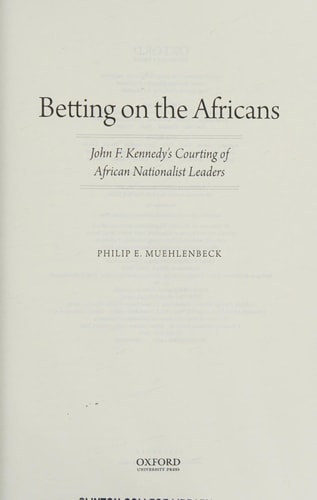
Betting on the Africans: John F. Kennedy's Courting of African Nationalist Leaders
0
0
As an Amazon Associate and affiliate partner, Menrva Books earns from qualifying purchases. Learn more
Author Description
As a presidential candidate, John F. Kennedy established a reputation across Africa as a sympathetic supporter of African nationalism, who if elected would realign Washington's priorities toward the continent. Once in office, Kennedy indeed made changing the image of America in Africa a top priority of his administration, believing that the Cold War could be won or lost depending upon whether Washington or Moscow won the hearts and minds of the Third World.Africa was particularly important because a wave of independence saw nineteen newly independent African states admitted into the United Nations during 1960-61. By 1962, 31 of the UN's 110 member states were from the African continent, and both Washington and Moscow sought to add these countries to their respective voting bloc. Kennedy feared that neglect of the newly decolonized countries of the world would result in the rise of anti-Americanism and needed to be addressed irrespective of the Cold War. Philip Muehlenbeck demonstrates how Kennedy used all means at his disposal-economic, cultural, personal-to appeal to the leaders of the developing world, including Nkrumah, Senghor, Touré, Nyerere, and Ben Bella.Drawing on archival sources from Africa, the United States, and the United Kingdom, Muehlenbeck closely examines Kennedy's policies towards Guinea, Ghana, Ivory Coast, Liberia, Egypt, Algeria, Tanganyika, and South Africa, which were to a large extent successful in winning the sympathies of its peoples, while at the same time alienating more traditional American allies. Betting on the Africans adds an important chapter to the historiography of John F. Kennedy's Cold War strategy as well as the history of decolonization.
Menrva's Summary
THE THESIS
This book investigates how the John F. Kennedy administration strategically courted African nationalist leaders to secure geopolitical influence during the height of the Cold War. Philip E. Muehlenbeck, a historian specializing in U.S. foreign policy, utilizes extensive archival research from three continents to analyze the shift in American diplomatic priorities. He argues that Kennedy viewed the newly independent African states as a critical battleground for global ideological dominance, necessitating a departure from traditional colonial-aligned policies. The text examines the specific economic, cultural, and personal diplomatic maneuvers employed by the administration to prevent these nations from aligning with the Soviet Union.
THE SCOPE MAP
What You Will Find
- Analysis of U.S. foreign policy toward Guinea, Ghana, Ivory Coast, Liberia, Egypt, Algeria, Tanganyika, and South Africa.
- Examination of the impact of the 1960-61 wave of African independence on United Nations voting blocs.
- Utilization of primary source archival documents from the United States, the United Kingdom, and various African nations.
- Evaluation of the tension between Kennedy's African outreach and the interests of traditional European allies.
THE AUTHORITY PERSPECTIVE
Scholars and historians recognize this work as a significant contribution to the historiography of the Kennedy administration and the broader context of decolonization. Readers frequently note the rigorous use of multi-national archives, which provides a balanced view of Cold War diplomacy beyond the standard Washington-centric narrative.
Page Count:
360
Publication Date:
2012-02-06
Publisher:
Oxford University Press
ISBN-10:
019539609X
ISBN-13:
9780195396096
History
Biography
Africa - History
International relations
African history
Nationalism africa
United States
Cold War
Community Tags
Similar Books