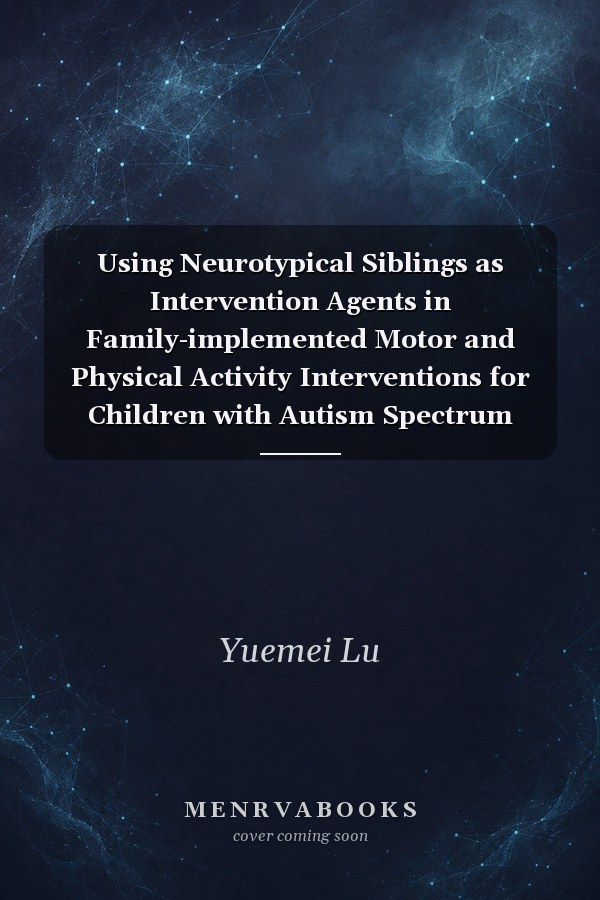
Using Neurotypical Siblings as Intervention Agents in Family-implemented Motor and Physical Activity Interventions for Children with Autism Spectrum Disorder
0
0
As an Amazon Associate and affiliate partner, Menrva Books earns from qualifying purchases. Learn more
Author Description
There is a consensus that individuals with Autism Spectrum Disorder (ASD) fall short of the recommended 60-minute daily moderate-to-vigorous physical activity (MVPA), and some experience motor delays and abnormalities. Yet ASD interventions focusing on addressing these challenges are insufficient in the existing literature. Research evidence supports the effectiveness of neurotypical (NT) sibling involvement in ASD intervention, therefore, using NT siblings as intervention agents to promote PA and motor skills in their sister/brother with ASD may be a viable option. The three studies within this dissertation were conducted during the COVID-19 pandemic when free and unstructured physical activity (PA) was suggested to be achieved by playing with siblings. This dissertation's first investigation was a qualitative study investigating the perceptions of NT siblings and caregivers on prospective sibling-guided motor intervention in children with ASD. The principal investigator also gathered information that ball games, in-person format, once or twice per week frequency, weekend days, and 30-minute session duration were most preferred. Prior to designing and implementing the PA intervention, a cross-sectional study was conducted with 18 parent-ASD-NT triads (54 participants) to understand PA, parental perceived motor competence, and PA-related family dynamics in children with ASD during COVID-19. The findings from the PA questionnaire revealed that children with ASD spent a significantly greater amount of time in sedentary behaviors (mean = 2379.06 mins; SD = 1480.10) during an entire week than in leisure time activities (mean = 316.88 mins; SD = 301.48) and sports activities (mean = 183.00 mins; SD = 153.94). Also, parents perceived their children's competence on most skills listed in the parental proxy of the Pictorial Scale of Perceived Movement Skill Competence (PMSC-parent) as not too good or sort of good. In addition, it was indicated that NT siblings' self-efficacy
Menrva's Summary
THE THESIS
This dissertation investigates the under-addressed challenges of motor delays and insufficient physical activity in children with Autism Spectrum Disorder (ASD). It explores the potential of leveraging neurotypical (NT) siblings as intervention agents to promote physical activity (PA) and motor skills in their siblings with ASD. The research addresses the gap in existing literature by examining the feasibility and effectiveness of family-implemented interventions, particularly within the context of the COVID-19 pandemic where sibling play was encouraged.
THE SCOPE MAP
- Qualitative exploration of NT siblings' and caregivers' perceptions of sibling-guided motor interventions for children with ASD.
- Identification of preferred intervention characteristics, including preferred activities (ball games), format (in-person), frequency (once or twice per week), timing (weekend days), and duration (30-minute sessions).
- Cross-sectional study data on PA levels, parental perceived motor competence, and PA-related family dynamics in children with ASD during the COVID-19 pandemic.
- Findings indicating significantly higher sedentary behavior in children with ASD compared to leisure time and sports activities.
- Parental perceptions of children's motor skill competence as generally not too good or sort of good.
- Analysis of NT siblings' self-efficacy in promoting PA and motor skills in their siblings with ASD.
THE AUTHORITY PERSPECTIVE
The research presented in this dissertation addresses a critical need for effective interventions to improve physical activity and motor skills in children with Autism Spectrum Disorder (ASD). The findings highlight the potential of utilizing neurotypical siblings as intervention agents, a strategy supported by evidence of sibling involvement in ASD interventions. The studies conducted during the COVID-19 pandemic provide timely insights into family dynamics and preferences for intervention delivery. The data suggests a significant gap in physical activity for children with ASD and a need for improved perceived motor competence, underscoring the importance of the proposed intervention approaches.
Page Count:
203
Publication Date:
2022-01-01
Publisher:
Michigan State University. Kinesiology
ISBN-13:
9798438746072
Health
Psychology
Non-Fiction
Special Education
Family Dynamics
Physical Therapy
Intervention Strategies
Community Tags
Similar Books

Reader Comments
Share Your Thoughts
No comments yet. Be the first to share your thoughts!