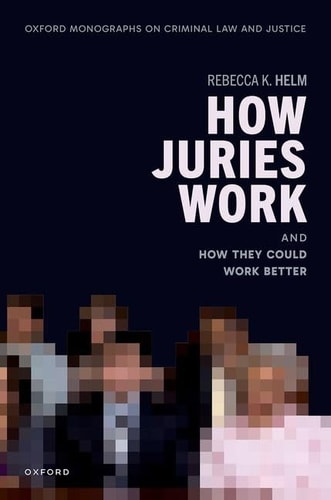
How Juries Work: And How They Could Work Better
0
0
As an Amazon Associate and affiliate partner, Menrva Books earns from qualifying purchases. Learn more
Author Description
The majority of common law jurisdictions, and some civil law jurisdictions, use juries composed of citizens drawn from the general population to deliberate and reach collective verdicts in criminal cases. Juries are relied on to use their collective judgment to reach verdicts that accord with normative legal goals; for example, by being accurate and fair.How Juries Work suggests that, though important symbolically, the current jury system is not necessarily well designed to meet the demands of modern society, which increasingly requires evidence-based procedure that is carefully designed to achieve normative goals. Rebecca K. Helm proposes new models of how jurors and juries function in practice, informed by psychological theory and empirical research, which provide a framework to interpret and integrate the large body of existing work on jury decision-making. Drawing on this framework, Helm highlights the deficiencies and strengths of the jury as a legal fact-finder, providing key insights into how to minimize deficiencies and maximize strengths through trial procedure. The book concludes with a set of timely evidence-based suggestions as to how procedure surrounding trial by jury might be altered to enhance the administration of justice in the many jurisdictions where the criminal law jury is utilized.How Juries Work integrates legal and psychological theory and research to present a comprehensive assessment of the modern criminal law jury, and of how evidence-based research can improve jury performance.
Menrva's Summary
THE THESIS
This book investigates whether the contemporary jury system effectively meets the normative goals of modern criminal law and how empirical research can improve its performance. Rebecca K. Helm, an expert in legal psychology, utilizes a synthesis of psychological theory and empirical data to evaluate the functional mechanics of jury decision-making. She argues that while the jury holds significant symbolic value, current procedural designs often fail to align with the requirements of modern justice systems. By establishing a new framework for understanding juror behavior, the author provides a roadmap for integrating scientific evidence into legal practice.
THE SCOPE MAP
What You Will Find
- Analysis of jury decision-making processes through the lens of psychological theory.
- Evidence-based proposals for procedural reform in criminal trials.
- A comprehensive assessment of the strengths and weaknesses of the jury as a legal fact-finder.
Scope Limits
- The text focuses primarily on criminal law juries in common law and select civil law jurisdictions.
- It does not provide a historical account of the jury system, focusing instead on contemporary functional performance.
THE AUTHORITY PERSPECTIVE
Legal scholars and practitioners view this work as a significant contribution to the intersection of psychology and criminal procedure. Experts highlight the text for its rigorous application of empirical research to long-standing legal traditions, making it a valuable resource for those interested in judicial reform.
Page Count:
240
Publication Date:
2024-10-11
Publisher:
Oxford University Press
ISBN-10:
0192857290
ISBN-13:
9780192857293
Non-Fiction
Psychology
Jurisprudence
Legal Theory
Systems Theory
Law
Criminal Law
Sociology
Rules & Procedures
Community Tags
Similar Books