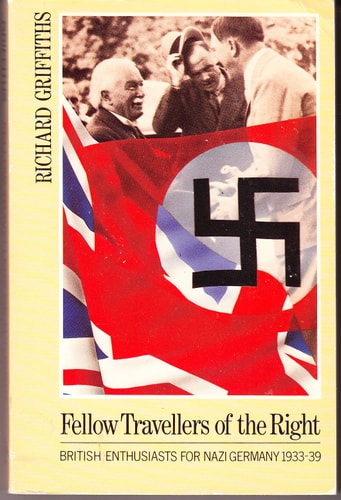
Fellow Travellers of the Right: British Enthusiasts for Nazi Germany, 1933-9
0
0
As an Amazon Associate and affiliate partner, Menrva Books earns from qualifying purchases. Learn more
Author Description
Richard Griffiths's previous book was a highly praised biography of Marshal Petain, published in 1970. In his new book, he has turned his formidable powers to analysing the motivation of British people in the Thirties who, broadly speaking, were enthusiasts for Nazi Germany. They formed a significant section of opinion. By recourse to and careful study of original documents, he has built up a picture which is surprisingly different from that created by the generalisations of hindsight.Approval of Nazi Germany was not, when at its height the prerogative of fascist and extremist groups. It affected a remarkably wide area of society, and could be found in people of all walks of life and of most political opinions. Surprisingly, its highest point was in the mid-Thirties, in the years 1936 and 1937, and not in the first flush of the new regime. Many of its proponents were among the most patriotic of British citizens.This is not a book about 'appeasement', numerous studies of which already exist. Where those who feature centrally in this book differ from most appeasers is in their positive approval of Nazi Germany, as opposed to the mere desire to get on with her for contingent reasons. For this reason, albeit their attitudes ranged from polite acquiescence to white-hot ardour, the author has dubbed them 'enthusiasts'.
Menrva's Summary
THE THESIS
This work investigates the motivations and social breadth of British citizens who actively supported Nazi Germany between 1933 and 1939. Richard Griffiths, a historian noted for his biographical research, utilizes primary source documents to challenge the conventional historical narrative that support for the Nazi regime was limited to fringe extremist groups. He argues that such enthusiasm permeated various levels of British society and political thought, peaking during the mid-1930s rather than at the regime's inception.
THE SCOPE MAP
What You Will Find
- Analysis of British public opinion regarding Nazi Germany from 1933 to 1939
- Examination of the distinction between political appeasement and ideological enthusiasm
- Case studies of individuals across diverse social and political backgrounds
Scope Limits
- Does not provide a comprehensive history of the policy of appeasement
- Focuses primarily on the ideological supporters rather than the diplomatic or military actors of the era
THE AUTHORITY PERSPECTIVE
Historians and scholars recognize this text as a significant contribution to the study of British political culture during the interwar period. Readers frequently note the meticulous use of primary documentation to dismantle simplistic historical generalizations about the era.
Page Count:
410
Publication Date:
1983-03-17
Publisher:
Oxford University Press
ISBN-10:
0192851160
ISBN-13:
9780192851161
History
Nazi Germany
Fascism
Germany
20th Century
Political History
British History
Community Tags
Similar Books