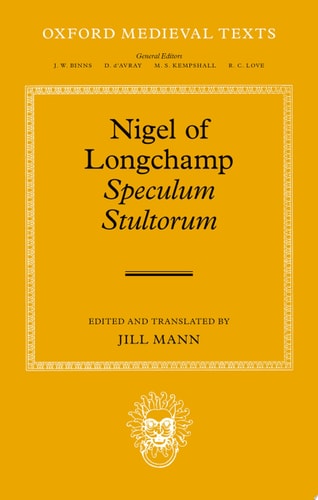
Nigel of Longchamp: Speculum Stultorum
0
0
As an Amazon Associate and affiliate partner, Menrva Books earns from qualifying purchases. Learn more
Author Description
An edition and English translation of the Speculum Stultorum (The Mirror for Fools), a long Latin beast epic written near the end of the twelfth century by a monk of Christ Church, Canterbury. This was one of the most popular works of the Middle Ages, a favourite of Chaucer, Gower, and Henryson, and was copied for over three centuries, with a circulation extending as far as eastern Europe. It is not only a milestone in the history of medieval beast epic, but a rich source of information about contemporary life and events at Canterbury. The work is dedicated to William Longchamp, who was Richard I's chancellor, and the significance of this fact is shown.This is a highly entertaining narrative about a donkey who longs to have a longer tail and journeys to Salerno to buy some (imaginary) medicines which will provide it. When his medicines are destroyed in an accident, he decides to become learned instead, and goes off to study at the university of Paris for seven years, but can still say only 'heehaw'. Interwoven into this simple narrative are other stories and long rhetorical set-pieces which satirise the distorted values of contemporary religious life or the corruption of the papal curia, and describe the qualities of an ideal bishop (which the donkey hopes to become).
Menrva's Summary
THE PULSE
A dissatisfied donkey named Burnellus embarks on a quest to lengthen his tail, only to find himself entangled in a series of misadventures that expose the absurdities of medieval society. Driven by a desire for physical transformation and social advancement, the protagonist encounters various obstacles that highlight the folly of human ambition. The narrative, written in Latin verse, utilizes the beast epic tradition to mirror the structures of twelfth-century life. Through a blend of picaresque movement and didactic digressions, the text critiques the intellectual and ecclesiastical institutions of the era.
INSIDE THE PAGES
- Beast epic narrative structure
- Satirical commentary on religious life
- Allegorical character archetypes
- Rhetorical set-pieces and moralizing digressions
- Critique of the papal curia
- Exploration of academic life in Paris
- Didactic focus on the qualities of an ideal bishop
- Use of humor to address contemporary corruption
THE COLLECTIVE ECHO
Scholars and readers frequently highlight the work as a significant bridge between classical beast fables and the later satirical traditions of Chaucer and Gower. Discussion often centers on the effectiveness of the donkey's quest as a vehicle for social critique, noting how the absurdity of the premise allows for sharp commentary on institutional greed. Critics emphasize the importance of the text in understanding the cultural and political climate of twelfth-century Canterbury. The balance between the lighthearted narrative of the donkey and the dense, rhetorical passages remains a primary focus for those analyzing the evolution of medieval humor. Readers often appreciate the historical context provided by the translation, which clarifies the complex political references embedded within the satire.
Page Count:
656
Publication Date:
2023-09-15
Publisher:
Oxford University Press
ISBN-10:
0192857711
ISBN-13:
9780192857712
Poetry
Classics
Satire
Medieval
Latin
Middle Ages
Europe
Beast Epic
Community Tags
Similar Books