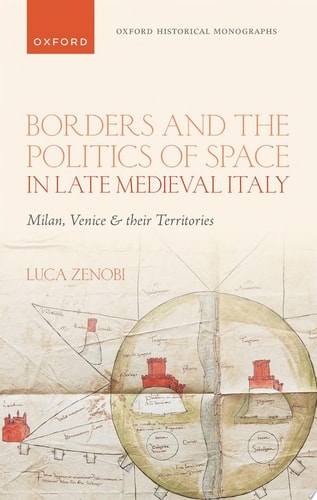
Borders and the Politics of Space in Late Medieval Italy: Milan, Venice, and their Territories
0
0
As an Amazon Associate and affiliate partner, Menrva Books earns from qualifying purchases. Learn more
Author Description
Space matters. It situates our history, structures our daily lives, and often determines what we can and cannot do. Borders are central to this reality. Tools and symbols of separation, power, and identity, they bring people together as much as they set them apart. This book explores how borders were understood, made, and encountered at the end of the Middle Ages, and what they can tell us about the spatial fabric of society at the threshold of modernity. It shows that pre-modern borders were nothing like the fuzzy lines they are typically made out to be, that border-making was rarely a top-down process and should instead be studied as an interactive endeavour, and that space was shaped by communities far more than states in this period.At its core, Borders and the Politics of Space in Late Medieval Italy is the account of a frontier which would mark the Italian peninsula for centuries, that between the territories of the Duchy of Milan and those of the Republic of Venice. But it is also a study of how rulers and subjects alike defined spaces they could call their own. Luca Zenobi combines methods from several disciplines and applies them to a range of evidence from twenty different libraries and archives, including theoretical treatises and pragmatic records, written chronicles and cartographic visualisations, private documents and official correspondence. The cast of characters is equally eclectic, featuring influential thinkers and pragmatic statesmen, zealous factions and clumsy bureaucrats, hopeless beggars and ambitious princes. On the border, their stories intersect and reveal their part in a shared history.
Menrva's Summary
THE THESIS
This book investigates how borders functioned as complex, interactive social and political constructs in late medieval Italy rather than as static, top-down lines of demarcation. Dr. Luca Zenobi, a specialist in late medieval Italian history, utilizes an extensive array of primary sources—ranging from official state correspondence to private chronicles—to challenge the traditional view of pre-modern frontiers. He argues that the spatial organization of the Italian peninsula was a collaborative process involving both ruling elites and local communities, effectively reshaping our understanding of state formation and territorial identity at the dawn of the modern era.
THE SCOPE MAP
What You Will Find
- A detailed analysis of the frontier between the Duchy of Milan and the Republic of Venice.
- A multi-disciplinary methodology incorporating political theory, cartography, and archival research.
- Evidence drawn from twenty distinct libraries and archives across Italy.
- An examination of how diverse social actors, from princes to peasants, negotiated and defined territorial boundaries.
THE AUTHORITY PERSPECTIVE
Scholars recognize this work as a significant contribution to the study of medieval political geography and statecraft. The text is noted for its rigorous archival foundation and its ability to synthesize complex administrative records into a coherent narrative of spatial politics.
Page Count:
288
Publication Date:
2023-01-01
Publisher:
Oxford University Press
ISBN-10:
0198876866
ISBN-13:
9780198876861
History
Middle Ages
European History
Italy
Geography
Political History
Europe
Community Tags
Similar Books