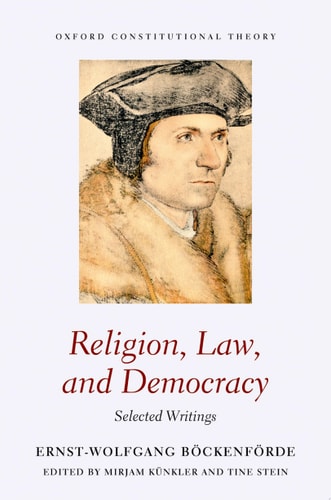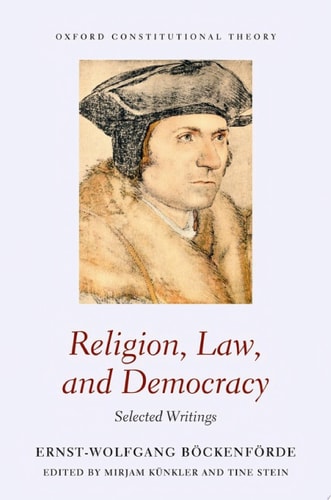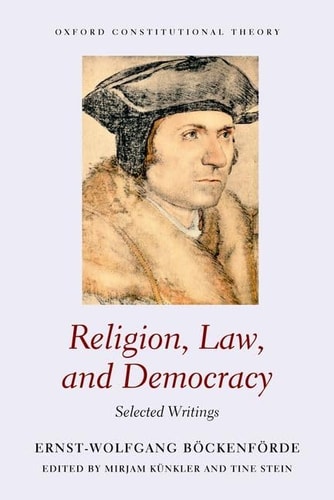
Religion, Law, and Democracy: Selected Writings
0
0
As an Amazon Associate and affiliate partner, Menrva Books earns from qualifying purchases. Learn more
Author Description
Ernst-Wolfgang Böckenförde (1930-2019) was one of Europe's foremost legal scholars and political thinkers. As a scholar of constitutional law and a judge on Germany's Federal Constitutional Court (1983-1996), Böckenförde was a major contributor to contemporary debates in legal and political theory, to the conceptual framework of the modern state and its presuppositions, and to contested political issues such as the constitutional status of the state of emergency, citizenship rights, bioethical politics, and the challenges of European integration. His writings have shaped not only academic but also wider public debates from the 1950s to the present, to an extent that few European scholars can match. As a federal constitutional judge and holder of a trusted public office, Böckenförde has influenced the way academics and citizens think about law and politics. During his tenure on the Court, several path-breaking decisions for the Federal Republic of Germany were handed down, including decisions on the deployment of missiles, the law on political parties, the regulation of abortion, and the process of European integration.This second volume in the first representative edition in English of Böckenförde's writings brings together his essays on religion, law, and democracy. The volume is organized in five sections: I. the Catholic Church and Political Order; II. State and Secularity; III. the Theology of Law and its Relation to Political Theory; IV. Norms and the Principle of Human Dignity; and V. Excerpts from a biographical interview. Sections I, II, III, and IV are preceded by an editors' introduction to the articles as well as running editorial commentary to the work.
Menrva's Summary
THE THESIS
This volume investigates the complex interplay between religious tradition, secular legal frameworks, and the democratic legitimacy of the modern state. Ernst-Wolfgang Böckenförde, a distinguished German constitutional scholar and former judge on the Federal Constitutional Court, utilizes his extensive experience in jurisprudence to analyze the presuppositions of the liberal state. He argues that the state relies on normative foundations that it cannot generate through its own legal mechanisms, necessitating a critical examination of the relationship between secular law and religious ethics.
THE SCOPE MAP
What You Will Find
- Analysis of the Catholic Church's role in political order
- Theoretical frameworks regarding state secularity and neutrality
- Discussions on the theology of law and human dignity
- Biographical insights into the author's intellectual development
Scope Limits
- The text does not provide a comprehensive history of German law
- It does not offer practical legal advice or case law summaries for non-academic practitioners
THE AUTHORITY PERSPECTIVE
Scholars and legal theorists identify this collection as a primary resource for understanding the intellectual history of the German Federal Constitutional Court. Readers frequently note the academic density of the prose, which requires a foundational understanding of European political philosophy to fully grasp the nuances of the author's arguments.
Page Count:
480
Publication Date:
2022-10-31
Publisher:
Oxford University Press
ISBN-10:
0192857037
ISBN-13:
9780192857033
Philosophy
Constitutional Law
Law
Political Theory
Religion and Politics
European History
Community Tags
Similar Books