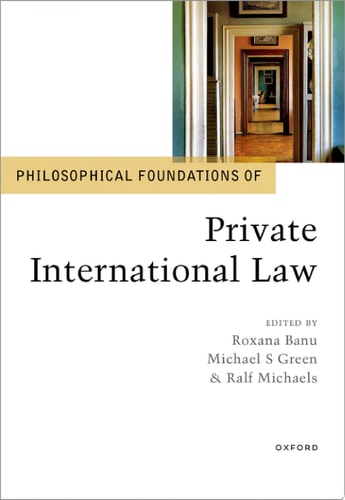
Philosophical Foundations of Private International Law
0
0
As an Amazon Associate and affiliate partner, Menrva Books earns from qualifying purchases. Learn more
Author Description
Elaborating On Arguments From Kant's Legal Philosophy, The Chapter Argues That The Concept Of Private Rights Leads To The Idea Of Necessary Unity In Choice Of Law. Unity Is Achieved If Legislators And Courts Of All States Subject The Articulation Of Conflict-of-law Rules To The Same Idea Of Justice. The Relevant Idea Of Justice Is Neither The Idea Of Comparatively More Impairment Of Governmental Interests Nor An Idea Of Conflicts Justice. Rather, Justice In Choice Of Law Is About Reasonably Assigning Jurisdiction To Prescribe Private-law Rules. It Is Argued, That The Principle For The Assignment Is The Principle Of Territoriality: Private-law Claims Are Subject To That State's Jurisdiction In Whose Territory The Object Of The Infringed Right (thing Or Another's Deed) Is Located. Contrary To Widespread Belief, It Is This Principle Which Actually Governs The European Union's Choice-of-law Rules. However, In Contrast To The Current Law In The Eu (and Elsewhere), The Idea Of Choice Of Law As Assigning Jurisdiction Blocks The Idea That Private Parties Could Have The Power To Choose The Applicable Law At Will. This Understanding Of The Basic Rules In Choice Of Law Leaves Room For Politics, In A Wide Sense That Includes The Public Interests Of A Particular State On The One Hand And Imperatives From Good Morals On The Other
Menrva's Summary
THE THESIS
This work investigates the core question of how private rights and Kantian legal philosophy necessitate a unified approach to choice of law in international legal systems. The authors, Michael J.B. Green, Ralf Michaels, and Roxana Banu, utilize a framework rooted in Kantian justice to argue that choice of law should be understood as the reasonable assignment of jurisdiction to prescribe private-law rules. By critiquing existing governmental interest and conflict-justice models, the text proposes a principle of territoriality as the foundational mechanism for assigning jurisdiction.
THE SCOPE MAP
What You Will Find
- An analysis of Kantian legal philosophy applied to private international law.
- A critique of current choice-of-law rules within the European Union.
- A theoretical framework for assigning jurisdiction based on territoriality.
Scope Limits
- The text does not provide a comprehensive survey of all global private international law statutes.
- It does not offer a practical manual for litigation or procedural law application.
THE AUTHORITY PERSPECTIVE
Legal scholars and practitioners frequently note the high level of academic density and philosophical rigor present in this analysis. Experts highlight this as a significant contribution to the theoretical foundations of conflict-of-law rules and their intersection with political morality.
Page Count:
432
Publication Date:
2024-11-11
Publisher:
Oxford University Press
ISBN-10:
0192858777
ISBN-13:
9780192858771
Philosophy
Systems Theory
International Law
Law
Legal Theory
Jurisprudence
Community Tags
Similar Books