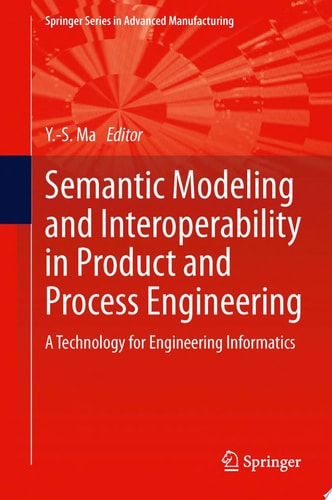
Semantic Modeling and Interoperability in Product and Process Engineering
0
0
As an Amazon Associate and affiliate partner, Menrva Books earns from qualifying purchases. Learn more
Author Description
In the past decade, feature-based design and manufacturing has gained some momentum in various engineering domains to represent and reuse semantic patterns with effective applicability. However, the actual scope of feature application is still very limited. Semantic Modeling and Interoperability in Product and Process Engineering provides a systematic solution for the challenging engineering informatics field aiming at the enhancement of sustainable knowledge representation, implementation and reuse in an open and yet practically manageable scale. This semantic modeling technology supports uniform, multi-facet and multi-level collaborative system engineering with heterogeneous computer-aided tools, such as CADCAM, CAE, and ERP. This presented unified feature model can be applied to product and process representation, development, implementation and management. Practical case studies and test samples are provided to illustrate applications which can be implemented by the readers in real-world scenarios. By expanding on well-known feature-based design and manufacturing approach, Semantic Modeling and Interoperability in Product and Process Engineering provides a valuable reference for researchers, practitioners and students from both academia and engineering field.
Menrva's Summary
THE THESIS
This book presents a systematic solution for enhancing knowledge representation, implementation, and reuse in engineering informatics. The author, Yongsheng Ma, addresses the limitations of current feature-based design and manufacturing approaches by proposing a semantic modeling technology. This technology aims to support collaborative system engineering across heterogeneous computer-aided tools like CAD/CAM, CAE, and ERP. The unified feature model presented can be applied to product and process representation, development, implementation, and management.
THE SCOPE MAP
- A systematic solution for semantic modeling and interoperability in product and process engineering.
- Enhancement of sustainable knowledge representation, implementation, and reuse.
- Support for uniform, multi-facet, and multi-level collaborative system engineering.
- Application to heterogeneous computer-aided tools (CAD/CAM, CAE, ERP).
- A unified feature model for product and process representation, development, implementation, and management.
- Practical case studies and test samples for real-world implementation.
THE AUTHORITY PERSPECTIVE
The book is positioned as a valuable reference for researchers, practitioners, and students in academia and the engineering field. It expands upon the well-known feature-based design and manufacturing approach, offering a practical framework for implementing semantic modeling technologies. The inclusion of case studies suggests a focus on actionable insights for readers seeking to improve knowledge management in engineering contexts.
Page Count:
389
Publication Date:
2013-06-06
Publisher:
Springer Nature
ISBN-10:
1447150732
ISBN-13:
9781447150732
Economics
Non-Fiction
Science & Technology
Product Development
Computer Science
Process Engineering
Engineering
Community Tags
Similar Books