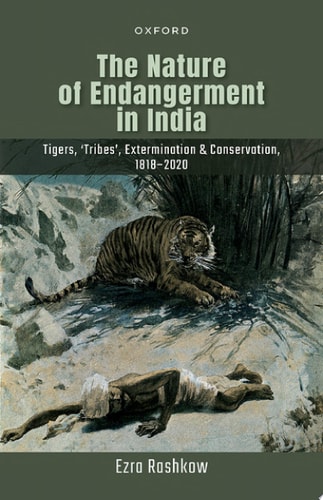
The Nature of Endangerment in India: Tigers, 'Tribes', Extermination & Conservation, 1818-2020
0
0
As an Amazon Associate and affiliate partner, Menrva Books earns from qualifying purchases. Learn more
Author Description
Perhaps no category of people on earth has been perceived as more endangered, nor subjected to more conservation efforts, than indigenous peoples. And in India, calls for the conservation of Adivasi culture have often reached a fever pitch, especially amongst urban middle-class activists and global civil society groups. But are India's 'tribes' really endangered? Do they face extinction? And is this threat somehow comparable to the threat of extinction facing tigers and other wildlife? Combining years of fieldwork and archival research with rigorous theoretical interrogations, this book examines fears of interlinking biological and cultural (or biocultural) diversity loss-particularly in regard to Bhil and Gond communities facing conservation and development-induced displacement in western and central India. It also problematizes the frequent usage of dehumanizing animal analogies that carelessly equate the fates of endangered species and societies. In doing so, it offers a global intellectual history of the concepts of endangerment and extinction, demonstrating that anxieties over tribal extinction existed long before there was even scientific awareness of the extinction of non-human species. The book is not a history or an ethnography of the tribes of India, but rather a history of discourses-including Adivasis' own-about what is often perceived to be the fundamental question for nearly all indigenous peoples in the modern world: the question of survival.
Menrva's Summary
THE THESIS
This book investigates the intellectual history and sociopolitical implications of equating the endangerment of indigenous peoples with the extinction of non-human species. Ezra Rashkow, an expert in environmental history and South Asian studies, utilizes a combination of extensive archival research and ethnographic fieldwork to challenge the rhetoric surrounding the survival of Adivasi communities. He argues that the frequent conflation of biological and cultural loss serves to dehumanize indigenous groups while obscuring the complex political realities of displacement and development in India.
THE SCOPE MAP
What You Will Find
- A historical analysis of extinction discourses from 1818 to 2020.
- Case studies focusing on the Bhil and Gond communities in western and central India.
- A theoretical framework examining the intersection of biocultural diversity and conservation policy.
Scope Limits
- The book does not function as a comprehensive ethnography or general history of all Indian tribes.
- It does not provide a biological assessment of wildlife conservation programs outside of their discursive relationship to human populations.
THE AUTHORITY PERSPECTIVE
Scholars in the fields of environmental history and anthropology recognize this work as a rigorous critique of the metaphors used in modern conservation movements. Readers frequently note the academic density of the prose and the author's success in deconstructing the historical origins of the 'tribal extinction' narrative.
Page Count:
394
Publication Date:
2023-01-01
Publisher:
Oxford University Press
ISBN-10:
0192868527
ISBN-13:
9780192868527
History
Natural Resources
Conservation
Asia history
India
Sociology
Anthropology
Community Tags
Similar Books