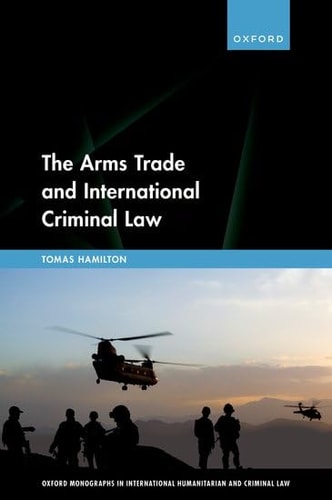
The Arms Trade and International Criminal Law: Reframing Accountability for Complicit Weapon Suppliers
0
0
As an Amazon Associate and affiliate partner, Menrva Books earns from qualifying purchases. Learn more
Author Description
Despite the establishment of UN embargoes, the Arms Trade Treaty (ATT), and the EU Common Position, arms export regulation suffers from significant legal and practical limitations. This book critically evaluates the existing body of 'Arms Trade Law', highlighting its inadequacies in preventing weapons from reaching perpetrators of mass violence.Drawing on interviews, participant observation, and empirical research to assess the perspectives of judges and lawyers, it also explores the International Criminal Court's narrow focus on prosecuting political and military leaders. Arguing that institutional attitudes and commitments contribute to a legal culture that obscures the potential for an arms trader case, the book illustrates these dynamics through a case study of the UN Security Council's response to the Second Congo War and the ICC's investigations in the DRC Situation, elucidating missed opportunities to enforce accountability against the entire spectrum of actors responsible for international crimes.Through detailed examination of the arms trade's complexities, The Arms Trade and International Criminal Law foregrounds the structural causes of atrocity and argues for broader accountability. It investigates how individuals-including corporate executives, state officials, and arms traffickers-can be held directly accountable for atrocities under international law, even when their actions are geographically or causally distant from the violence itself. Furthermore, by advancing a specific interpretation of the actus reus and mens rea elements of accomplice liability under Article 25 of the Rome Statute, this book argues for a robust legal basis upon which the ICC can prosecute arms traders. It therefore underscores how international criminal law can complement existing regulations by leveraging its expressive function to condemn all those who profit from atrocity.
Menrva's Summary
THE THESIS
This book investigates the legal and institutional barriers that prevent the prosecution of arms suppliers under international criminal law for their complicity in mass atrocities. Tomas Hamilton, a scholar in international humanitarian and criminal law, utilizes a combination of empirical research, legal analysis, and case studies to argue that current regulatory frameworks are insufficient. He proposes a reinterpretation of accomplice liability under the Rome Statute to hold corporate and state actors accountable for their role in facilitating international crimes.
THE SCOPE MAP
What You Will Find
- Analysis of the Arms Trade Treaty and EU Common Position regulations.
- Legal interpretation of actus reus and mens rea under Article 25 of the Rome Statute.
- Case study of the UN Security Council response to the Second Congo War.
- Empirical data derived from interviews with judges and legal practitioners.
Scope Limits
- The text does not provide a comprehensive history of the global arms trade.
- It does not offer a manual for corporate compliance or export licensing procedures.
THE AUTHORITY PERSPECTIVE
Legal scholars and practitioners view this work as a significant contribution to the discourse on corporate accountability within the International Criminal Court framework. Readers frequently note the academic density of the prose and the rigor of the author's legal arguments regarding accomplice liability.
Page Count:
256
Publication Date:
2025-05-27
Publisher:
Oxford University Press
ISBN-10:
0192868675
ISBN-13:
9780192868671
History
Criminal Law
International relations
Weapons & Warfare
International Law
Human rights
Arms Trade
Community Tags
Similar Books