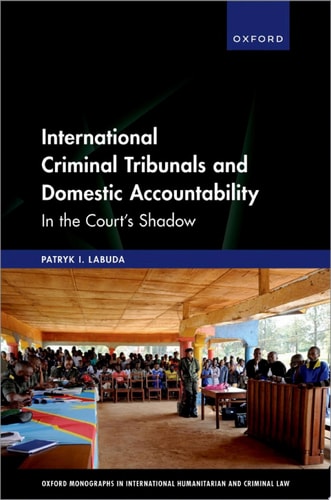
International Criminal Tribunals and Domestic Accountability: In the Court's Shadow
0
0
As an Amazon Associate and affiliate partner, Menrva Books earns from qualifying purchases. Learn more
Author Description
In the 1990s, the promise of justice for atrocity crimes was associated with the revival of international criminal tribunals (ICTs). More recently, however, there has been a renewed emphasis on domestic accountability for international crimes across the globe. In identifying a 'complementarity turn', a paradigm shift toward domestic accountability in the field of international criminal justice, this book investigates how the shadow of international criminal tribunals influences the treatment of serious crimes at the national level. Drawing on research and interviews in Rwanda, the Democratic Republic of Congo, and Sierra Leone, this book develops a tripartite framework to analyse how states and tribunals work with, despite, or against one another in the fight against impunity. While international prosecutors and judges use the principle of complementarity to foster cooperation and decrease tension with government actors, Patryk I. Labuda argues that too much deference by ICTs toward states reduces the likelihood of accountability and may enable national elites to consolidate authoritarian power. By interrogating how international accountability stakeholders relate to their domestic counterparts, International Criminal Tribunals and Domestic Accountability advocates improvements to ICTs' institutional design and more dynamic interactions with states to strengthen the enforcement of international criminal law.
Menrva's Summary
THE THESIS
This book investigates how the presence and influence of international criminal tribunals shape the effectiveness and political outcomes of domestic accountability efforts for atrocity crimes. Patryk I. Labuda, a scholar in international law, utilizes a comparative analysis of post-conflict states to evaluate the principle of complementarity. He argues that excessive deference by international institutions toward national governments can inadvertently facilitate the consolidation of authoritarian power rather than ensuring justice.
THE SCOPE MAP
What You Will Find
- A tripartite framework for analyzing state-tribunal interactions
- Empirical research and interview data from Rwanda, the Democratic Republic of Congo, and Sierra Leone
- Critical assessment of the institutional design of international criminal tribunals
Scope Limits
- The analysis does not cover the entirety of international criminal law, focusing specifically on the interplay between international tribunals and domestic legal systems
- The study does not provide a comprehensive history of every international tribunal, but rather selects specific case studies to illustrate the 'complementarity turn'
THE AUTHORITY PERSPECTIVE
Legal scholars and practitioners view this work as a significant contribution to the discourse on the limitations of international justice mechanisms. Experts frequently note the academic density of the prose and the rigorous methodology applied to the study of state-tribunal dynamics.
Page Count:
368
Publication Date:
2023-01-01
Publisher:
OUP Oxford
ISBN-10:
0192639560
ISBN-13:
9780192639561
Professional Career & Trade
International relations
Human rights
Law
Criminal Law
International Law