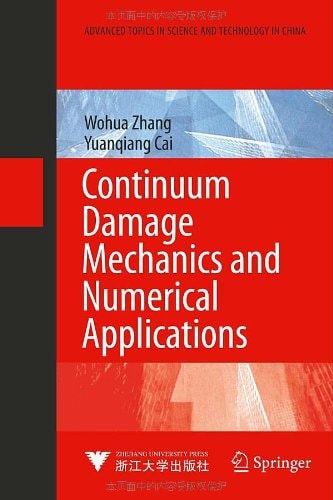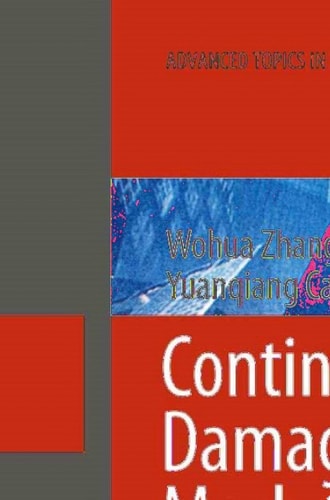
Continuum Damage Mechanics and Numerical Applications
0
0
As an Amazon Associate and affiliate partner, Menrva Books earns from qualifying purchases. Learn more
Author Description
"Continuum Damage Mechanics and Numerical Applications" presents a systematic development of the theory of Continuum Damage Mechanics and its numerical engineering applications using a unified form of the mathematical formulations in anisotropic and isotropic damage models. The theoretical framework is based on the thermodynamic theory of energy and material dissipation and is described by a set of fundamental formulations of constitutive equations of damaged materials, development equations of the damaged state, and evolution equations of micro-structures. According to concepts of damage-dissipation of the material state and effective evolution of material properties, all these advanced equations, which take nonsymmetrized effects of damage aspects into account, are developed and modified from the traditional general failure models so they are more easily applied and verified in a wide range of engineering practices by experimental testing. Dr. Wohua Zhang is a Professor at Engineering Mechanics Research Center in Zhejiang University of China. Dr. Yuanqiang Cai is a Professor at Department of Civil Engineering in Zhejiang University of China.
Menrva's Summary
THE THESIS
This book systematically develops the theory of Continuum Damage Mechanics and its numerical engineering applications. It is based on the thermodynamic theory of energy and material dissipation, presenting fundamental formulations for constitutive equations of damaged materials, development equations of the damaged state, and evolution equations of micro-structures. The authors modify traditional general failure models to incorporate nonsymmetrized effects of damage, making them more applicable and verifiable in engineering practices through experimental testing.
THE SCOPE MAP
- Unified form of mathematical formulations for anisotropic and isotropic damage models.
- Theoretical framework based on thermodynamic theory of energy and material dissipation.
- Fundamental formulations of constitutive equations for damaged materials.
- Development equations for the damaged state.
- Evolution equations for micro-structures.
- Advanced equations considering nonsymmetrized effects of damage.
- Modifications of traditional general failure models for practical engineering applications.
- Emphasis on experimental verification of theoretical models.
THE AUTHORITY PERSPECTIVE
The book is presented as a comprehensive resource for understanding and applying Continuum Damage Mechanics in engineering. Its theoretical foundation in thermodynamics and detailed formulation of constitutive and evolution equations suggest a rigorous, academic approach. The authors' stated aim to bridge theory with practical engineering applications through experimental verification indicates a focus on both foundational knowledge and empirical validation, likely appealing to researchers and practitioners in materials science and computational mechanics.
Page Count:
1000
Publication Date:
2010-11-19
Publisher:
Springer Nature
ISBN-10:
3642047084
ISBN-13:
9783642047084
Non-Fiction
Science
Computational Mechanics
Engineering