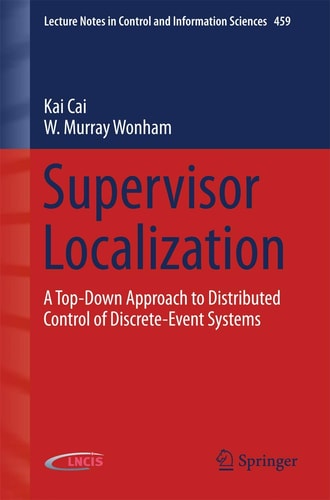
Supervisor Localization: A Top-Down Approach to Distributed Control of Discrete-Event Systems
0
0
As an Amazon Associate and affiliate partner, Menrva Books earns from qualifying purchases. Learn more
Author Description
This monograph presents a systematic top-down approach to distributed control synthesis of discrete-event systems (DES). The approach is called supervisor localization; its essence is the allocation of external supervisory control action to individual component agents as their internal control strategies. The procedure is: first synthesize a monolithic supervisor, to achieve globally optimal and nonblocking controlled behavior, then decompose the monolithic supervisor into local controllers, one for each agent. The collective behavior of the resulting local controllers is identical to that achieved by the monolithic supervisor. The basic localization theory is first presented in the Ramadge–Wonham language-based supervisory control framework, then demonstrated with distributed control examples of multi-robot formations, manufacturing systems, and distributed algorithms. An architectural approach is adopted to apply localization to large-scale DES; this yields a heterarchical localization procedure, which is also demonstrated with benchmark examples. Moreover, a state-based framework, state-tree structures, is exploited for efficient computation of localization. Finally localization is extended to timed DES, which addresses distributed control synthesis with temporal specifications. The authors’ TCT software and sourcecode will help the reader to reproduce the results demonstrated in the examples. Academic researchers and graduate students interested in discrete-event and distributed systems and control will find this book an instructive resource. It will also be useful for researchers in manufacturing, supply-chain and logistics and practitioners in related industries.
Menrva's Summary
THE THESIS
This monograph introduces supervisor localization, a novel top-down methodology for the distributed control of discrete-event systems (DES). The core of this approach involves synthesizing a monolithic supervisor for globally optimal and nonblocking behavior, and then decomposing this into local control strategies for individual component agents. The collective outcome of these local controllers precisely mirrors the behavior of the original monolithic supervisor, ensuring consistent system-wide control. The theory is grounded in the Ramadge-Wonham language-based supervisory control framework and is illustrated through diverse examples including multi-robot formations, manufacturing systems, and distributed algorithms.
THE SCOPE MAP
- A systematic top-down approach to distributed control synthesis of discrete-event systems (DES) called supervisor localization.
- The procedure of synthesizing a monolithic supervisor and then decomposing it into local controllers for individual agents.
- Demonstration of the theory within the Ramadge-Wonham language-based supervisory control framework.
- Examples of distributed control applications in multi-robot formations, manufacturing systems, and distributed algorithms.
- An architectural approach for applying localization to large-scale DES, including a heterarchical localization procedure.
- Exploitation of state-tree structures for efficient computation of localization.
- Extension of localization to timed DES, addressing distributed control synthesis with temporal specifications.
THE AUTHORITY PERSPECTIVE
This book presents a detailed exposition of the supervisor localization methodology for discrete-event systems. The authors' TCT software and source code are provided to facilitate reproduction of the demonstrated results. It is positioned as an instructive resource for academic researchers and graduate students in discrete-event and distributed systems, as well as for practitioners in manufacturing and logistics.
Page Count:
199
Publication Date:
2015-07-08
Publisher:
Springer International Publishing
ISBN-10:
3319204955
ISBN-13:
9783319204956
Non-Fiction
Science
Computer Science
Distributed Systems
Robotics
Manufacturing Systems
Control systems
Community Tags
Similar Books