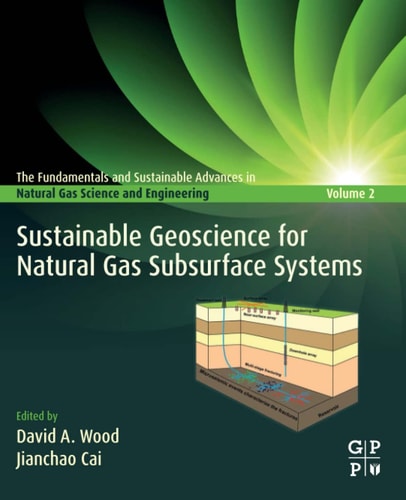
Sustainable Geoscience for Natural Gas SubSurface Systems
0
0
As an Amazon Associate and affiliate partner, Menrva Books earns from qualifying purchases. Learn more
Author Description
Sustainable Geoscience for Natural Gas SubSurface Systems delivers many of the scientific fundamentals needed in the natural gas industry, including coal-seam gas reservoir characterization and fracture analysis modeling for shale and tight gas reservoirs. Advanced research includes machine learning applications for well log and facies analysis, 3D gas property geological modeling, and X-ray CT scanning to reduce environmental hazards. Supported by corporate and academic contributors, along with two well-distinguished editors, the book gives today's natural gas engineers both fundamentals and advances in a convenient resource, with a zero-carbon future in mind. Includes structured case studies to illustrate how new principles can be applied in practical situations Helps readers understand advanced topics, including machine learning applications to optimize predictions, controls and improve knowledge-based applications Provides tactics to accelerate emission reductions Teaches gas fracturing mechanics aimed at reducing environmental impacts, along with enhanced oil recovery technologies that capture carbon dioxide
Menrva's Summary
THE THESIS
This book provides essential scientific fundamentals and advanced research for the natural gas industry, focusing on sustainable practices and a zero-carbon future. It covers topics such as coal-seam gas reservoir characterization, fracture analysis modeling for shale and tight gas, and machine learning applications for well log and facies analysis. The text also explores 3D geological modeling of gas properties and the use of X-ray CT scanning to mitigate environmental hazards, supported by contributions from industry and academia.
THE SCOPE MAP
- Fundamentals of natural gas subsurface systems.
- Advanced research in machine learning for well log and facies analysis.
- 3D geological modeling of gas properties.
- Techniques for reducing environmental hazards using X-ray CT scanning.
- Structured case studies illustrating practical applications of new principles.
- Tactics for accelerating emission reductions in the natural gas sector.
- Methods for gas fracturing mechanics aimed at reducing environmental impacts.
- Enhanced oil recovery technologies with carbon capture capabilities.
THE AUTHORITY PERSPECTIVE
The book is presented as a comprehensive resource for natural gas engineers, offering both foundational knowledge and cutting-edge research. It emphasizes practical applications through case studies and integrates advanced topics like machine learning to optimize predictions and controls. The text aims to equip professionals with the tools and understanding necessary to pursue emission reductions and minimize environmental impacts within the industry, aligning with a zero-carbon future.
Page Count:
434
Publication Date:
2021-11-04
Publisher:
Elsevier Science
ISBN-10:
0323854656
ISBN-13:
9780323854658
Non-Fiction
Science
Geoscience
Case studies
Machine Learning
Natural Gas
Sustainability
Community Tags
Similar Books