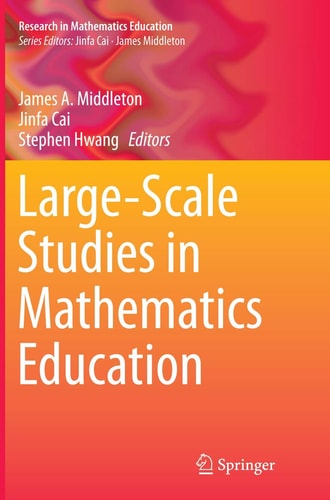
Large-Scale Studies in Mathematics Education
0
0
As an Amazon Associate and affiliate partner, Menrva Books earns from qualifying purchases. Learn more
Author Description
In recent years, funding agencies like the Institute of Educational Sciences and the National Science Foundation have increasingly emphasized large-scale studies with experimental and quasi-experimental designs looking for 'objective truths'. Educational researchers have recently begun to use large-scale studies to understand what really works, from developing interventions, to validation studies of the intervention, and then to efficacy studies and the final "scale-up" for large implementation of an intervention. Moreover, modeling student learning developmentally, taking into account cohort factors, issues of socioeconomics, local political context and the presence or absence of interventions requires the use of large data sets, wherein these variables can be sampled adequately and inferences made. Inroads in quantitative methods have been made in the psychometric and sociometric literatures, but these methods are not yet common knowledge in the mathematics education community. In fact, currently there is no volume devoted to discussion of issues related to large-scale studies and to report findings from them. This volume is unique as it directly discusses methodological issue in large-scale studies and reports empirical data from large-scale studies.
Menrva's Summary
THE THESIS
This volume addresses the growing emphasis on large-scale studies in mathematics education and the methodological challenges associated with them. The book explores the increasing use of experimental and quasi-experimental designs by funding agencies to identify effective educational interventions. It details the process from intervention development and validation to efficacy studies and large-scale implementation, while also considering developmental modeling of student learning that accounts for cohort factors, socioeconomic issues, and contextual influences. The text aims to bridge the gap between advancements in quantitative methods in psychometric and sociometric literatures and their current adoption within the mathematics education community, offering a unique compilation of methodological discussions and empirical findings from large-scale studies.
THE SCOPE MAP
- Methodological issues specific to large-scale studies in mathematics education.
- Empirical data and findings from large-scale studies.
- Discussion of the role of experimental and quasi-experimental designs.
- Considerations for modeling student learning developmentally, including cohort factors and socioeconomic influences.
- Insights into the process of intervention development, validation, efficacy studies, and scale-up.
- Application of quantitative methods relevant to educational research.
THE AUTHORITY PERSPECTIVE
The book is positioned as a unique contribution to the mathematics education community, addressing a gap in existing literature by focusing specifically on the methodological aspects and empirical findings of large-scale studies. The content suggests a focus on rigorous research practices and quantitative analysis, likely appealing to researchers and academics seeking to understand or conduct large-scale educational research. The emphasis on 'objective truths' and 'what really works' indicates a pragmatic and evidence-based approach to educational inquiry.
Page Count:
432
Publication Date:
2016-10-09
Publisher:
Springer International Publishing
ISBN-10:
3319344692
ISBN-13:
9783319344690
Non-Fiction
Science & Technology
Mathematics Education
Education
Research Methods
Quantitative Methods
Educational Research
Community Tags
Other Editions(2)

Similar Books