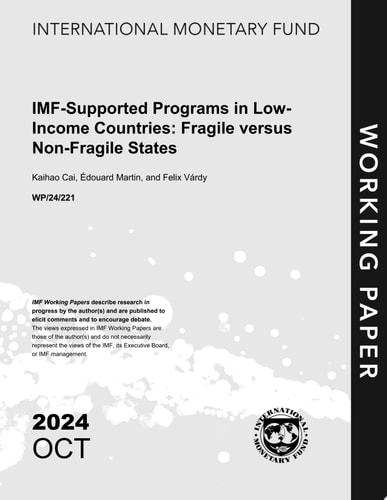
IMF-Supported Programs in Low-Income Countries: Fragile Versus Non-Fragile States
0
0
As an Amazon Associate and affiliate partner, Menrva Books earns from qualifying purchases. Learn more
Author Description
This paper examines the macroeconomic frameworks of IMF-supported programs with low-income countries from 2009 to 2022, focusing on how macroeconomic targets and their achievement differ between fragile and conflicted-affected states (FCS) and non-FCS. Key findings include similar program targets for FCS and non-FCS, optimism in all dimensions considered other than inflation, and no significant correlation between targets and outcomes. For variables other than inflation, country-independent targets equal to the mean or median outcomes of other programs outperform program projections as predictors of actual outcomes. This underscores the challenges in setting realistic, country and program-specific targets in IMF-supported programs with low-income countries. Finally, we discuss potential caveats, including GDP rebenchmarking, non-linear relationship between initial conditions and targets, and repeat programs. We do not study, and make no claims about, causality.
Menrva's Summary
THE THESIS
This paper investigates the effectiveness of macroeconomic frameworks in IMF-supported programs for low-income countries, specifically contrasting fragile states with non-fragile ones. The study analyzes programs from 2009 to 2022, examining how macroeconomic targets are set and achieved in fragile and conflict-affected states (FCS) compared to non-FCS. It reveals that program targets are often similar across both types of states, with optimism present in most dimensions except inflation, and a notable lack of correlation between set targets and actual outcomes. The research highlights the difficulty in establishing realistic, country-specific targets for these programs.
THE SCOPE MAP
- Analysis of IMF-supported programs in low-income countries from 2009 to 2022.
- Comparison of macroeconomic targets and outcomes between fragile/conflict-affected states (FCS) and non-FCS.
- Examination of optimism bias in program targets, excluding inflation.
- Assessment of the correlation between program targets and actual outcomes.
- Evaluation of country-independent targets (mean/median outcomes) as predictors versus program projections.
- Discussion of potential caveats including GDP rebenchmarking and repeat programs.
- Focus on macroeconomic frameworks and their achievement.
THE AUTHORITY PERSPECTIVE
This paper offers a data-driven analysis of IMF programs in vulnerable economies, suggesting that current target-setting practices may not adequately reflect the realities of fragile states. The findings indicate a consistent optimism in projections across various economic indicators, with a particular challenge in achieving non-inflationary goals. The study's comparison of target-setting strategies between fragile and non-fragile states provides valuable insights for policymakers and economists involved in international development finance. It underscores the need for more nuanced and context-specific approaches to program design in low-income countries.
Page Count:
59
Publication Date:
2024-10-11
Publisher:
International Monetary Fund
ISBN-13:
9798400289866
Politics
Non-Fiction
Economics
Community Tags
Similar Books