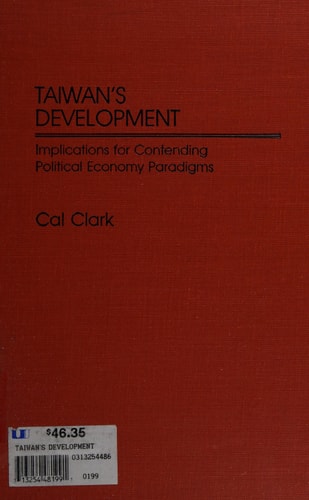
Taiwan's Development: Implications for Contending Political Economy Paradigms
0
0
As an Amazon Associate and affiliate partner, Menrva Books earns from qualifying purchases. Learn more
Author Description
Known as the Taiwan Miracle, the Republic of China on Taiwan (R.O.C.) has, over the past thirty-five years, experienced one of the world's highest rates of economic growth. Arguing that major theoretical frameworks for analyzing international political economy are often too simplistic in that they omit key factors or overly generalize from relationships found only in limited situations, Clark uses a detailed case history of the R.O.C. to suggest not only that development and dependency in contemporary society are extremely complex and indeterminate processes, but that development in Taiwan deviates significantly from the postulates of the two leading paradigms of international political economy. To go even further, Clark states that Taiwan's economic growth and transformation resulted from its deviation from the normal dependency syndrome. Indeed, a development strategy based on economic flexibility and periodic regime change that has made this flexibility possible are hallmarks in Taiwan's success story. The United States and other advanced industrial economies whose past successes have created economic and political barriers to future adaptation can be better understood in terms of the characteristics of R.O.C.'s development strategy. Part I of the three-part work focuses on environment, first discussing various paradigms and theories about development and then presenting an historical overview of Taiwan. The second part investigates Taiwan's international role, political development, and rapid economic growth. The volume closes with a chapter devoted to the implications of the Taiwan experience and political economy paradigms. Eight figures and thirty-five tables illustrate facets of Taiwan's development, including government structure, indicators of agricultural development, industrialization, educational progress, and export performance, among others. Because of the detailed presentations of political economy theories and their variants, especially in
Menrva's Summary
THE THESIS
This book investigates the complex and indeterminate processes of development and dependency in contemporary society, using Taiwan's economic success as a case study to challenge existing political economy paradigms. The author, Cal Clark, argues that major theoretical frameworks are often too simplistic, omitting key factors or generalizing from limited situations. By detailing the Republic of China on Taiwan's (R.O.C.) economic growth, Clark suggests that Taiwan's development deviates significantly from the postulates of leading international political economy paradigms, particularly the dependency syndrome. The book posits that Taiwan's economic flexibility and the periodic regime changes enabling it are hallmarks of its success, offering insights for advanced industrial economies facing adaptation barriers.
THE SCOPE MAP
- Analysis of major theoretical frameworks for international political economy, highlighting their limitations.
- Detailed case history of the Republic of China on Taiwan (R.O.C.) and its economic development.
- Examination of Taiwan's deviation from standard development and dependency models.
- Exploration of the role of economic flexibility and regime change in Taiwan's success.
- Discussion of implications for understanding advanced industrial economies.
- Historical overview of Taiwan's development.
- Investigation of Taiwan's international role and political development.
- Presentation of eight figures and thirty-five tables illustrating various facets of Taiwan's development.
THE AUTHORITY PERSPECTIVE
The book is presented as a detailed case study of Taiwan's economic miracle, challenging established political economy paradigms. It aims to demonstrate the complexity of development and dependency by showing how Taiwan's success stemmed from deviations from common theoretical postulates. The work is structured to first explore theoretical environments and Taiwan's history, then its international and political development, and finally, the implications for broader political economy. The inclusion of numerous figures and tables suggests a data-rich analysis intended for scholars and policymakers interested in comparative economic development.
Page Count:
283
Publication Date:
1989-10-06
Publisher:
Holtzbrinck
ISBN-10:
0313254486
ISBN-13:
9780313254482
History
Economics
Non-Fiction
Asian Studies
Taiwan
Community Tags
Similar Books