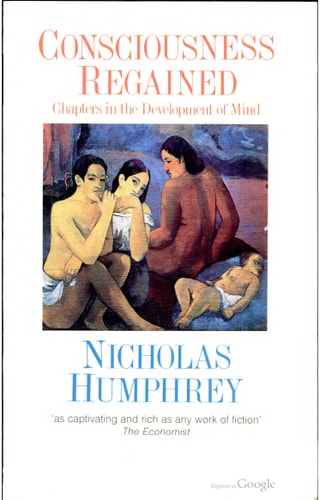
Consciousness Regained: Chapters in the Development of Mind
0
0
As an Amazon Associate and affiliate partner, Menrva Books earns from qualifying purchases. Learn more
Author Description
This book, the first by one of England's outstanding experimental psychologists, brings together a selection of essays on human consciousness, self-knowledge, aesthetics, religion, parapsychology, philosophy of mind, and the atom bomb. Throughout, Humphrey is concerned with the evolution of mind, and he puts forth the theory that self-awareness developed because it is biologically advantageous. "Fluently and pleasantly written, often enlivened by wit, always easy to follow." --Times Literary Supplement. "Always stimulating and fun to read.... Humphrey writes with elegance and force, and... his ideas... are always stimulating. Even the reader who disagrees with his arguments will derive pleasure." --Nature
Menrva's Summary
THE THESIS
This collection investigates the evolutionary origins of human consciousness and the biological utility of self-awareness. Nicholas Humphrey, a prominent experimental psychologist, synthesizes diverse observations from biology, philosophy, and social science to argue that the development of a conscious mind provided a distinct survival advantage to early humans. By examining the intersection of internal experience and external behavior, he constructs a framework that positions self-knowledge as a functional adaptation rather than a mere byproduct of cognitive complexity.
THE SCOPE MAP
What You Will Find
- Analysis of the evolutionary trajectory of human self-awareness
- Philosophical inquiries into aesthetics, religion, and parapsychology
- Commentary on the psychological implications of modern technological threats like the atom bomb
- Theoretical models linking biological fitness to subjective experience
Scope Limits
- The text does not provide a comprehensive clinical manual for psychological treatment
- It avoids exhaustive technical neurobiological data in favor of conceptual and philosophical synthesis
THE AUTHORITY PERSPECTIVE
Critics and peers frequently highlight the accessibility and wit of Humphrey's prose, noting that he successfully bridges the gap between academic rigor and general interest. Experts often cite this work as a foundational exploration of the evolutionary psychology of the mind that remains relevant for its clarity and provocative theoretical stance.
Page Count:
192
Publication Date:
1984-11-29
Publisher:
Oxford University Press
ISBN-10:
0192860526
ISBN-13:
9780192860521
Psychology
Science
Essays
Evolutionary Biology
Consciousness
Philosophy of