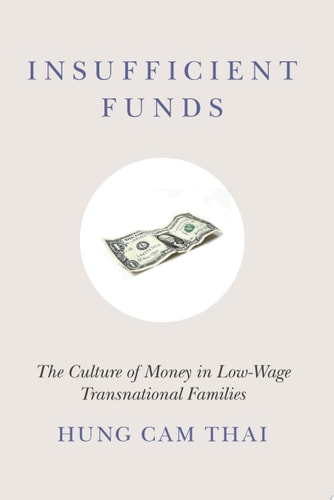
Insufficient Funds
0
0
As an Amazon Associate and affiliate partner, Menrva Books earns from qualifying purchases. Learn more
Author Description
Every year migrants across the globe send more than $500 billion to relatives in their home countries, and this circulation of money has important personal, cultural, and emotional implications for the immigrants and their family members alike. Insufficient Funds tells the story of how low-wage Vietnamese immigrants in the United States and their poor, non-migrant family members give, receive, and spend money. Drawing on interviews and fieldwork with more than one hundred members of transnational families, Hung Cam Thai examines how and why immigrants, who largely earn low wages as hairdressers, cleaners, and other "invisible" workers, send home a substantial portion of their earnings, as well as spend lavishly on relatives during return trips. Extending beyond mere altruism, this spending is motivated by complex social obligations and the desire to gain self-worth despite their limited economic opportunities in the United States. At the same time, such remittances raise expectations for standards of living, producing a cascade effect that monetizes family relationships. Insufficient Funds powerfully illuminates these and other contradictions associated with money and its new meanings in an increasingly transnational world.
Menrva's Summary
THE THESIS
This book investigates the complex financial and social dynamics of money circulation within transnational immigrant families. Drawing on extensive fieldwork and interviews with over one hundred members of Vietnamese immigrant families in the United States and their relatives in their home countries, Hung Cam Thai explores the motivations behind remittances and the impact of these financial flows. The study examines how low-wage immigrants, often working in service industries, manage to send significant portions of their earnings home and spend generously during visits, driven by social obligations and a search for self-worth. It further analyzes how these remittances create expectations for higher living standards and can lead to the monetization of family relationships in an increasingly globalized world.
THE SCOPE MAP
- Analysis of remittance practices among low-wage Vietnamese immigrants in the United States.
- Exploration of the personal, cultural, and emotional implications of sending and receiving money across borders.
- Examination of the motivations behind immigrant spending, including social obligations and the pursuit of self-worth.
- Discussion of how remittances shape expectations and potentially monetize family relationships.
- Insights from over one hundred interviews and fieldwork with transnational families.
- Focus on the economic and social contradictions inherent in globalized financial flows.
THE AUTHORITY PERSPECTIVE
The book offers a powerful illumination of the contradictions associated with money and its evolving meanings in a transnational context. It is recognized for its deep dive into the lived experiences of low-wage immigrants and their families, providing a nuanced understanding of financial practices beyond simple altruism. The research highlights the intricate interplay of economic necessity, social obligation, and personal identity that shapes remittance behaviors. This work is considered a significant contribution to the study of migration, economics, and cultural sociology.
Page Count:
304
Publication Date:
2014-04-09
Publisher:
Stanford University Press
ISBN-10:
0804790566
ISBN-13:
9780804790567
Economics
Non-Fiction
History
Transnationalism
Sociology
Migration Studies
Community Tags
Similar Books