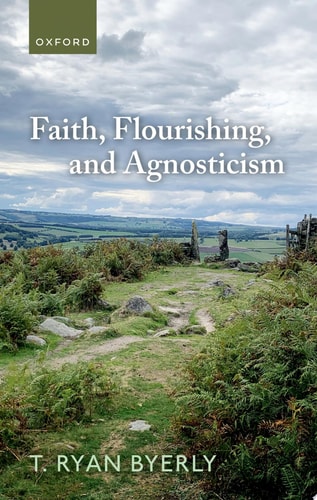
Faith, Flourishing, and Agnosticism
0
0
As an Amazon Associate and affiliate partner, Menrva Books earns from qualifying purchases. Learn more
Author Description
Faith, Flourishing, and Agnosticism uses conceptual and empirical methods to argue that the many individuals who have ambiguous evidence for God can grow in virtue and attain greater flourishing by engaging in practices of faith toward God. The book develops a way of thinking about God, called minimal theism. It argues that a sizeable number of people have ambiguous evidence for God, and it provides support for arguments for agnosticism through an evaluation of theistic and atheistic arguments and higher-order evidence about God. It discusses what kind of cognitive commitments toward God are required to engage in faith practices such as thanking or praising God, and develops unique arguments that these can be supplied by beliefs or non-doxastic assumptions but not other states.Four pathways whereby individuals with ambiguous evidence for God can grow in virtue through such faith practices are identified. First, they can grow in general virtuous tendencies to give other people the benefit of the doubt by giving God the benefit of the doubt. Second, they can indirectly grow in a broad range of virtues by experiencing better mental health as a consequence of accepting God's love. Third, they can make skilled use of the worldview of minimal theism to cultivate transformative experiences of awe and connectedness, thereby supporting the specific virtue of spiritual excellence. Finally, by this same process, they can reap further downstream benefits in character growth, independently of whether spiritual excellence is virtuous.
Menrva's Summary
THE THESIS
This book investigates whether individuals who possess ambiguous evidence regarding the existence of God can still achieve personal flourishing and moral growth through the practice of faith. T. Ryan Byerly, a scholar in philosophy of religion, utilizes a combination of conceptual analysis and empirical research to propose a framework known as minimal theism. He argues that for those caught in epistemic uncertainty, engaging in specific faith-based practices provides a viable pathway to virtue and psychological well-being regardless of one's definitive stance on theism.
THE SCOPE MAP
What You Will Find
- A philosophical evaluation of theistic and atheistic arguments alongside higher-order evidence.
- The development of the minimal theism framework as a cognitive tool.
- Four distinct pathways for character development through faith-based practices.
- Analysis of cognitive commitments required for religious acts like praise and gratitude.
Scope Limits
- The text does not provide a definitive proof for or against the existence of God.
- It does not address specific denominational doctrines or sectarian religious practices.
THE AUTHORITY PERSPECTIVE
Scholars in the philosophy of religion recognize this work as a significant contribution to the intersection of virtue ethics and religious epistemology. Readers frequently note the academic density of the prose, which is designed for those familiar with contemporary analytic philosophy.
Page Count:
224
Publication Date:
2024-01-01
Publisher:
Oxford University Press
ISBN-10:
0192865714
ISBN-13:
9780192865717
Religion
Philosophy
Agnosticism
Virtue Ethics
Theology
Ethics
Theology doctrinal
Community Tags
Other Editions(2)

Similar Books