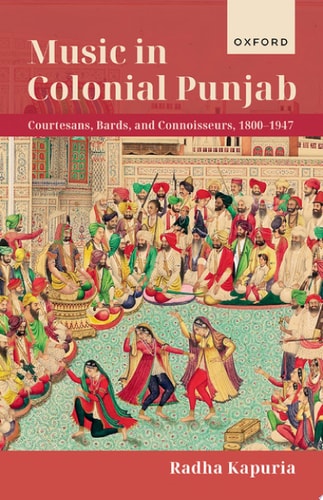
Music in Colonial Punjab: Courtesans, Bards, and Connoisseurs, 1800-1947
0
0
As an Amazon Associate and affiliate partner, Menrva Books earns from qualifying purchases. Learn more
Author Description
This book offers the first social history of music in undivided Punjab (1800-1947), beginning at the Lahore court of Maharaja Ranjit Singh and concluding at the Patiala royal darbar. It unearths new evidence for the centrality of female performers and classical music in a region primarily viewed as a folk music centre, featuring a range of musicians and dancers -from 'mirasis' (bards) and 'kalawants' (elite musicians), to 'kanjris' (subaltern female performers) and 'tawaifs' (courtesans). A central theme is the rise of new musical publics shaped by the anglicized Punjabi middle classes, and British colonialists' response to Punjab's performing communities. The book reveals a diverse connoisseurship for music with insights from history, ethnomusicology, and geography on an activity that still unites a region now divided between India and Pakistan.
Menrva's Summary
THE THESIS
This book investigates the social history of music in undivided Punjab between 1800 and 1947, challenging the perception of the region as solely a center for folk music. Dr. Radha Kapuria, a historian specializing in South Asian cultural history, utilizes archival research and interdisciplinary methodologies to reconstruct the musical landscape of the Lahore and Patiala courts. She argues that female performers and classical musicians were central to the region's cultural identity, even as colonial influence and the rise of an anglicized middle class transformed public consumption of the arts.
THE SCOPE MAP
What You Will Find
- Historical analysis of the Lahore court of Maharaja Ranjit Singh and the Patiala royal darbar.
- Examination of diverse musical communities including mirasis, kalawants, kanjris, and tawaifs.
- Investigation into the impact of British colonial policy on indigenous performing arts.
- Synthesis of ethnomusicological, geographical, and historical data.
Scope Limits
- The study is geographically confined to the undivided Punjab region.
- The analysis concludes at the 1947 partition and does not track post-independence musical developments.
THE AUTHORITY PERSPECTIVE
Scholars in South Asian studies identify this work as a significant contribution to the social history of music, noting its success in bridging the gap between historical research and ethnomusicology. Experts highlight the text as a foundational resource for understanding the complex intersection of gender, class, and colonial power in the performing arts of the Punjab.
Page Count:
410
Publication Date:
2023-08-30
Publisher:
Oxford University Press
ISBN-10:
0192867342
ISBN-13:
9780192867346
History
Criticism history
Asian History
Musicology
Social History
Community Tags
Similar Books