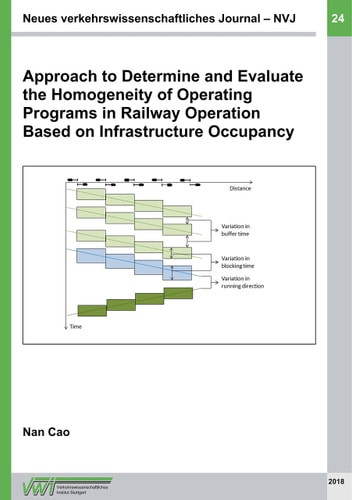
Neues verkehrswissenschaftliches Journal - Ausgabe 24: Approach to Determine and Evaluate the Homogeneity of Operating Programs in Railway Operation Based on Infrastructure Occupancy
0
0
As an Amazon Associate and affiliate partner, Menrva Books earns from qualifying purchases. Learn more
Author Description
An efficient utilization of existing infrastructure can be achieved with a more efficient operation. However, the occupancy of infrastructure has not been discussed in the existing definitions and evaluation methods of homogeneity. An extension of existing definitions is presented from the perspective of the infrastructure, which can be characterized by variations in blocking time, buffer time and running direction. The blocking time, buffer time and running direction describe the occupancy of train path on track sections based on the blocking time model. Accordingly, the homogeneity of operating programs is evaluated through three parameters, namely the homogeneity of blocking time (HBL), the homogeneity of buffer time (HBU) and the homogeneity of running direction (HRD). The overall homogeneity (OH) combined these three parameters to realize an integrity evaluation of homogeneity of operating programs. This new methodology can quantify the homogeneity of railway operations, not only for track sections but for an entire network, which contributes significantly to the efficient utilization of infrastructure. In addition, the interrelationship between homogeneity of operating programs and operation quality were investigated quantitatively for both each parameter of homogeneity and the overall homogeneity. The operation quality deteriorates with less homogeneous timetables, in which the variation in buffer time has a more significant influence. Finally, the influence of homogeneity of operating programs in capacity research is studied for different scenarios. The low traffic flow is more sensitive to the homogeneity of buffer time and the homogeneity of blocking time is more significant for high traffic flow.
Menrva's Summary
THE THESIS
This paper introduces a novel methodology to quantify and evaluate the homogeneity of operating programs in railway operations by focusing on infrastructure occupancy. The research addresses the gap in existing definitions by extending the concept of homogeneity to include variations in blocking time, buffer time, and running direction, all described through the blocking time model. It proposes three parameters—homogeneity of blocking time (HBL), homogeneity of buffer time (HBU), and homogeneity of running direction (HRD)—which are combined into an overall homogeneity (OH) metric for an integrated evaluation. This new approach enables the quantification of homogeneity across track sections and entire networks, significantly contributing to efficient infrastructure utilization.
THE SCOPE MAP
- A novel definition and evaluation method for infrastructure occupancy-based homogeneity in railway operating programs.
- Three key parameters: homogeneity of blocking time (HBL), homogeneity of buffer time (HBU), and homogeneity of running direction (HRD).
- An overall homogeneity (OH) metric combining the three parameters for an integrated evaluation.
- Quantitative investigation into the interrelationship between operating program homogeneity and operation quality.
- Analysis of the influence of homogeneity on capacity research across different traffic flow scenarios.
- Discussion on the differential impact of buffer time and blocking time homogeneity based on traffic flow levels.
THE AUTHORITY PERSPECTIVE
This technical paper presents a detailed quantitative analysis of railway operation homogeneity, focusing on infrastructure occupancy. It introduces a novel framework with specific parameters (HBL, HBU, HRD, OH) to measure and evaluate timetable efficiency. The research further explores the direct correlation between timetable homogeneity and operational quality, highlighting the significant influence of buffer time variations. The study also extends its analysis to capacity research, differentiating the impact of homogeneity metrics based on traffic flow conditions, making it a valuable contribution to the field of transportation science and railway engineering.
Page Count:
132
Publication Date:
2018-01-23
Publisher:
BoD – Books on Demand
ISBN-10:
3746033268
ISBN-13:
9783746033266
Non-Fiction
Science & Technology
Operations Research
Community Tags
Similar Books