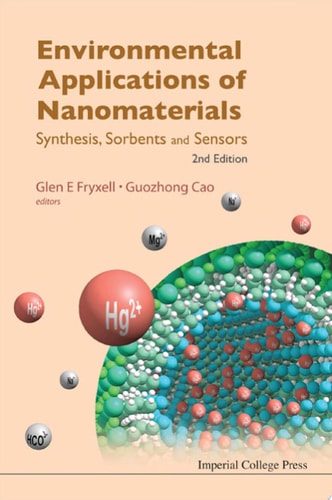
Environmental Applications of Nanomaterials: Synthesis, Sorbents and Sensors
0
0
As an Amazon Associate and affiliate partner, Menrva Books earns from qualifying purchases. Learn more
Author Description
This book is concerned with functional nanomaterials, materials containing specific, predictable nanostructures whose chemical composition, or interfacial structure enables them to perform a specific job: to destroy, sequester, or detect some material that constitutes an environmental threat. Nanomaterials have a number of features that make them ideally suited for this job: they have a high surface area, high reactivity, easy dispersability, and rapid diffusion, to name a few. The purpose of this book is to showcase how these features can be tailored to address some of the environmental remediation and sensing/detection problems faced by mankind today. A number of leading researchers have contributed to this volume, painting a picture of diverse synthetic strategies, structures, materials, and methods. The intent of this book is to showcase the current state of environmental nanomaterials in such a way as to be useful both as a research resource and as a graduate level textbook. We have organized this book into sections on nanoparticle-based remediation strategies, nanostructured inorganic materials (e.g. layered materials like the apatites), nanostructured organic/inorganic hybrid materials, and the use of nanomaterials to enhance the performance of sensors. Contents: Nanoparticle-based Approaches: Nanoparticle Metal Oxides for Chlorocarbon and Organophosphonate Remediation (Olga B Koper, Shyamala Rajagopalan, Slawomir Winecki and Kenneth J Klabunde) Nanoscale Zero-Valent Iron (nZVI) for Site Remediation (Daniel W Elliott, Hsing-Lung Lien and Wei-xian Zhang) Synthesis, Characterization, and Properties of Zero-Valent Iron Nanoparticles (Donald R Baer, Paul G Tratnyek, You Qiang, James E Amonette, John Linehan, Vaishnavi Sarathy, James T Nurmi, Chongmin Wang and J Antony) Nanostructured Inorganic Materials: Formation of Nanosized Apatite Crystals in Sediment for Containment and
Menrva's Summary
THE THESIS
This book investigates the application of functional nanomaterials for environmental remediation and sensing. It details how the unique properties of nanomaterials, such as high surface area and reactivity, can be engineered to address environmental threats like pollution and contamination. The volume showcases diverse synthetic strategies and materials contributed by leading researchers, aiming to serve as both a research resource and a graduate-level textbook.
THE SCOPE MAP
- Nanoparticle-based remediation strategies for environmental threats.
- Nanostructured inorganic materials, including layered materials like apatites.
- Nanostructured organic/inorganic hybrid materials.
- The use of nanomaterials to enhance sensor performance for detection.
- Specific case studies on nanoparticle metal oxides for chlorocarbon and organophosphonate remediation.
- Details on nanoscale zero-valent iron (nZVI) for site remediation.
- Information on the synthesis, characterization, and properties of zero-valent iron nanoparticles.
THE AUTHORITY PERSPECTIVE
The book is presented as a compilation of research from leading experts in the field of environmental nanomaterials. Its structure, divided into sections on remediation strategies, inorganic and hybrid materials, and sensor applications, suggests a comprehensive overview of current advancements. The content is intended to be useful for both researchers seeking a detailed resource and graduate students studying the subject.
Page Count:
752
Publication Date:
2012-07-24
Publisher:
Imperial College Press
ISBN-10:
190897706X
ISBN-13:
9781908977069
Non-Fiction
Science
Nanotechnology
Chemistry
Community Tags
Similar Books