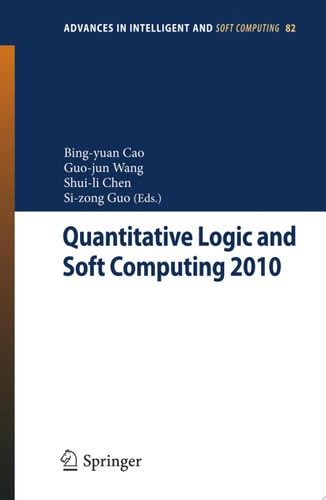
Quantitative Logic and Soft Computing
0
0
As an Amazon Associate and affiliate partner, Menrva Books earns from qualifying purchases. Learn more
Author Description
Admittedly, the notion “intelligence or intelligent computing” has been around us for several decades, implicitly indicating any non-conventional methods of solving complex system problems such as expert systems and intelligent control techniques that mimic human skill and replace human operators for automation. Various kinds of intelligent methods have been suggested, phenomenological or ontological, and we have been witnessing quite successful applications. On the other hand, “Soft Computing Techniques” is the concept coined by Lot? Zadeh, referring to “a set of approaches of computing which parallels the remarkable ability of the human mind to reason and learn in an environment of uncertainty, imprecision and partial truth. ” Such a notion is well contrasted with the conventionalbinary logic based hard c- puting and has been effectively utilized with the guiding principle of “exploiting the tolerance for uncertainty,imprecision and partial truth to achieve tractability, - bustness and low solution cost. ” The soft computing techniques are often employed as the technical entities in a tool box with tools being FL, ANN, Rough Set, GA etc. Based on one’s intuition and experience, an engineer can build and realize hum- like systems by smartly mixing proper technical tools effectivelyand ef?ciently in a wide range of?elds. For some time, the soft computing techniques are also referred to as intelligent computing tools.
Menrva's Summary
THE THESIS
The book investigates the integration of quantitative logic and soft computing techniques to address complex system problems. The authors, Bingyuan Cao, Guojun Wang, and Shuili Chen, explore the evolution of
THE SCOPE MAP
- Exploration of "intelligence" and intelligent computing concepts.
- Definition and principles of Soft Computing as coined by Lotfi Zadeh.
- Contrast between soft computing and conventional hard computing.
- Discussion of the guiding principle of exploiting tolerance for uncertainty, imprecision, and partial truth.
- Identification of common soft computing techniques (e.g., Fuzzy Logic, Artificial Neural Networks, Rough Set, Genetic Algorithms).
- Application of soft computing techniques in engineering and building human-like systems.
- The relationship between soft computing and intelligent computing tools.
THE AUTHORITY PERSPECTIVE
The book offers a foundational exploration into the concepts of quantitative logic and soft computing, tracing their development and applications. It aims to provide a comprehensive overview of techniques that mimic human reasoning and learning in uncertain environments. The text is likely to appeal to researchers and practitioners in artificial intelligence and computational intelligence seeking to understand the theoretical underpinnings and practical tools of soft computing. The authors' approach suggests a focus on the methodologies and their integration for solving complex problems.
Page Count:
800
Publication Date:
2010-10-14
Publisher:
Springer Nature
ISBN-10:
3642156606
ISBN-13:
9783642156601
Science
Non-Fiction
Logic
Computer Science
Community Tags
Similar Books