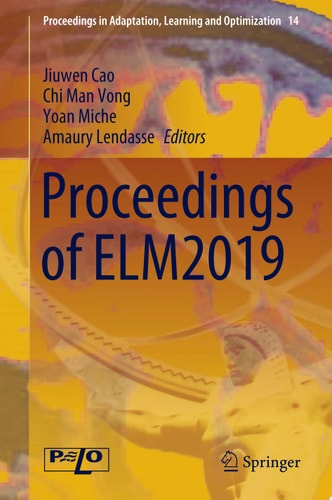
Proceedings of ELM2019
0
0
As an Amazon Associate and affiliate partner, Menrva Books earns from qualifying purchases. Learn more
Author Description
This book contains some selected papers from the International Conference on Extreme Learning Machine 2019, which was held in Yangzhou, China, December 14–16, 2019. Extreme Learning Machines (ELMs) aim to enable pervasive learning and pervasive intelligence. As advocated by ELM theories, it is exciting to see the convergence of machine learning and biological learning from the long-term point of view. ELM may be one of the fundamental ‘learning particles’ filling the gaps between machine learning and biological learning (of which activation functions are even unknown). ELM represents a suite of (machine and biological) learning techniques in which hidden neurons need not be tuned: inherited from their ancestors or randomly generated. ELM learning theories show that effective learning algorithms can be derived based on randomly generated hidden neurons (biological neurons, artificial neurons, wavelets, Fourier series, etc) as long as they are nonlinear piecewise continuous, independent of training data and application environments. Increasingly, evidence from neuroscience suggests that similar principles apply in biological learning systems. ELM theories and algorithms argue that “random hidden neurons” capture an essential aspect of biological learning mechanisms as well as the intuitive sense that the efficiency of biological learning need not rely on computing power of neurons. ELM theories thus hint at possible reasons why the brain is more intelligent and effective than current computers. The main theme of ELM2019 is Hierarchical ELM, AI for IoT, Synergy of Machine Learning and Biological Learning. This conference provides a forum for academics, researchers and engineers to share and exchange R&D experience on both theoretical studies and practical applications of the ELM technique and brain learning. This book covers theories, algorithms and applications of ELM. It gives readers a glance of the most recent advances of ELM.
Menrva's Summary
THE THESIS
This book presents selected papers from the International Conference on Extreme Learning Machine 2019, focusing on the convergence of machine learning and biological learning. The conference, held in Yangzhou, China, explored Extreme Learning Machines (ELMs) as a means to achieve pervasive learning and intelligence, drawing parallels between machine and biological learning mechanisms. ELM theories suggest that effective learning can occur with randomly generated hidden neurons, a principle increasingly supported by neuroscience, hinting at the brain's superior intelligence and efficiency compared to current computers. The main themes of ELM2019 were Hierarchical ELM, AI for IoT, and the Synergy of Machine Learning and Biological Learning, providing a platform for sharing R&D experience in both theoretical studies and practical applications.
THE SCOPE MAP
- Selected papers from the International Conference on Extreme Learning Machine 2019 (ELM2019).
- Theories and algorithms related to Extreme Learning Machines (ELMs).
- Discussions on the synergy between machine learning and biological learning.
- Applications of ELM in areas like AI for IoT.
- Exploration of Hierarchical ELM concepts.
- Insights into the fundamental principles of learning particles and random neuron generation.
- Recent advances and research findings in the field of ELM.
THE AUTHORITY PERSPECTIVE
This collection of papers from ELM2019 offers a specialized look into the field of Extreme Learning Machines, highlighting recent theoretical and applied research. The content is geared towards academics, researchers, and engineers actively involved in machine learning and artificial intelligence, particularly those interested in the intersection of computational and biological learning paradigms. The focus on hierarchical ELM and AI for IoT suggests a forward-looking perspective on the practical implementation of these advanced learning techniques. This volume serves as a valuable resource for understanding the cutting edge of ELM research and its potential implications.
Page Count:
182
Publication Date:
2020-09-11
Publisher:
Springer Nature
ISBN-10:
3030589897
ISBN-13:
9783030589899
Science & Technology
Science
Non-Fiction
Computer Science
Research
Machine Learning
Community Tags
Similar Books












Reader Comments
Share Your Thoughts
No comments yet. Be the first to share your thoughts!