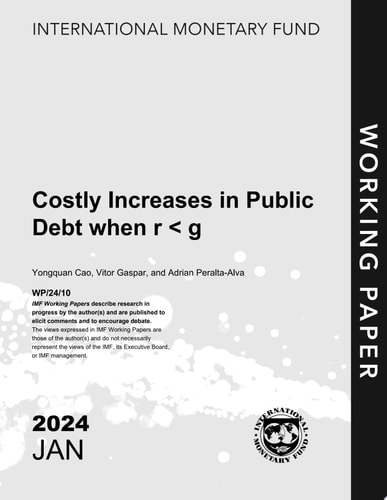
Costly Increases in Public Debt when R
0
0
As an Amazon Associate and affiliate partner, Menrva Books earns from qualifying purchases. Learn more
Author Description
This paper quantifies the costs of a permanent increase in debt to GDP. We employ a deterministic, overlapping generations model with two assets and no risk of default. The two assets are public debt and private (productive) capital. We assume that the return on private capital equals the interest rate on public debt plus an exogenously given spread. Employing a analytical version of the model we show an example in which a permanent rise in the public debt ratio leads to a significant reduction in steady-state GDP even as r
Menrva's Summary
THE THESIS
This paper quantifies the costs of a permanent increase in debt to GDP. The authors employ a deterministic, overlapping generations model with two assets and no risk of default: public debt and private (productive) capital. They assume the return on private capital equals the interest rate on public debt plus an exogenously given spread. Using an analytical version of the model, they demonstrate an example where a permanent rise in the public debt ratio leads to a significant reduction in steady-state GDP, even as the interest rate on debt remains constant.
THE SCOPE MAP
- Quantification of costs associated with a permanent increase in the debt-to-GDP ratio.
- Use of a deterministic, overlapping generations model.
- Inclusion of two assets: public debt and private capital.
- Assumption that the return on private capital equals the interest rate on public debt plus a spread.
- Demonstration of a permanent rise in the public debt ratio's impact on steady-state GDP.
- Analytical approach to modeling economic scenarios.
THE AUTHORITY PERSPECTIVE
The analysis presented in this paper focuses on the economic implications of rising public debt. The methodology employs a sophisticated economic model to quantify potential negative impacts on GDP. The findings suggest a direct correlation between increased debt ratios and reduced economic output, providing a quantitative perspective on fiscal policy considerations. This work contributes to the ongoing discussion regarding sustainable debt levels and their effect on long-term economic growth.
Page Count:
28
Publication Date:
2024-01-12
Publisher:
International Monetary Fund
ISBN-13:
9798400263620
Economics
Non-Fiction
Public Finance
Community Tags
Similar Books