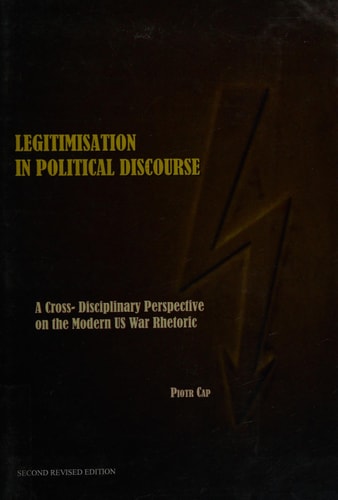
Legitimisation in Political Discourse
0
0
As an Amazon Associate and affiliate partner, Menrva Books earns from qualifying purchases. Learn more
Author Description
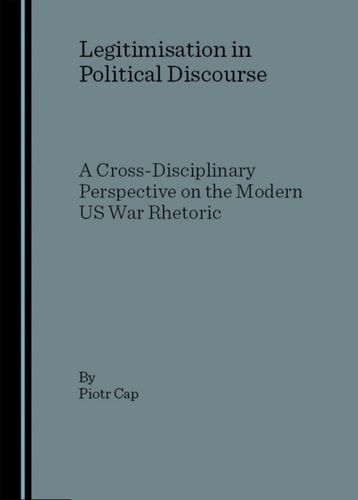
How did the Bush administration persuade Americans to go to war in Iraq? This book shows it was through “proximization”—a strategy that presents distant events as a direct, personal, and negative threat to legitimize pre-emptive action.
Menrva's Summary
THE THESIS
This book investigates how political actors legitimize actions, particularly war, through the strategic manipulation of distance in communication. It focuses on the concept of "proximization," a theory developed by the author, which posits that presenting distant events as immediate personal threats is a key method for persuading populations to accept pre-emptive or aggressive policies. The analysis examines how this linguistic and rhetorical strategy was employed by the Bush administration to justify the invasion of Iraq, demonstrating its effectiveness in shaping public opinion and political discourse.
THE SCOPE MAP
- Analysis of the "proximization" theory as a tool for political legitimation.
- Case study of the Bush administration's discourse leading up to the Iraq War.
- Examination of how distance (temporal, spatial, psychological) is manipulated in political rhetoric.
- Exploration of the relationship between language, threat perception, and policy justification.
THE AUTHORITY PERSPECTIVE
The book presents a novel theoretical framework, "proximization," for understanding how political leaders legitimize controversial actions like war. By analyzing the discourse surrounding the Iraq War, it offers a specific case study of this theory in practice. The work is likely to appeal to scholars and students of political communication, international relations, and rhetoric, providing a new lens through which to examine persuasive strategies in public discourse. The focus on the Bush administration's justification for the Iraq War grounds the theoretical discussion in a significant historical event.
Page Count:
190
Publication Date:
2010-01-01
Publisher:
Cambridge Scholars Publishing
ISBN-10:
1443845531
ISBN-13:
9781443845533
Politics
Non-Fiction
History
War Studies
Rhetoric
International relations
Community Tags
Other Editions(2)
Similar Books