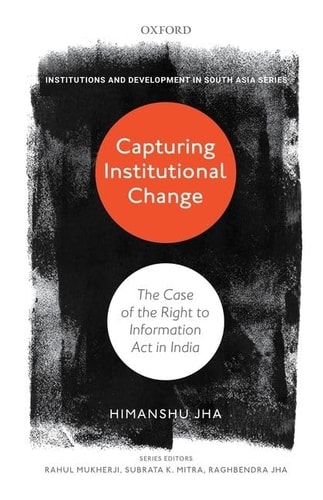
Capturing Institutional Change: The Case of the Right to Information Act in India
0
0
As an Amazon Associate and affiliate partner, Menrva Books earns from qualifying purchases. Learn more
Author Description
Institutions Are Norms That Undergird Organizations And Are Reflected In Laws And Practices. Over Time, Institutions Take Root And Persist As They Are Path Dependent And Thus Change Resistant. Therefore, It Is Puzzling When Institutions Change. One Such Puzzle Has Been The Enactment Of The Right To Information (rti) Act In India In 2005, Which Brought About Institutional Change By Transforming The 'information Regime'. Why Did The Government Upend The Norm Of Secrecy, Which Had Historically Been Entrenched Within The Indian State? This Book Uses Archival Material, Internal Government Documents, And Interviews To Understand The Why And How Of Institutional Change. It Demonstrates That The Institutional Change Resulted From 'ideas' Emerging Gradually And Incrementally, Leading To A 'tipping Point'. About The Idsa Series: This Series Interrogates The Interplay Between Globalization, The State, And Social Forces In The Making And Un-making Of Institutions In South Asia. Why Do Institutions Persist And Change? Do We Need To Transcend Materialism And Dwell In Ideas And Culture As Well To Understand Why Institutions Perform And Fail? The First Book In The Institutions And Development In South Asia Series, This Volume Studies The Historical Institutionalism In The Information Regime In India By Presenting An Alternative Narrative About The Evolution Of The Rti Act.
Menrva's Summary
THE THESIS
This book investigates the mechanisms of institutional change by analyzing the enactment of the Right to Information (RTI) Act in India in 2005. Himanshu Jha, a scholar of political science and institutional development, addresses the paradox of how a state historically committed to secrecy shifted toward transparency. By utilizing historical institutionalism, the author argues that institutional shifts occur through the gradual accumulation of ideas that eventually reach a critical tipping point, challenging the notion that institutions are purely path-dependent and resistant to change.
THE SCOPE MAP
What You Will Find
- Analysis of the evolution of the Indian information regime from colonial secrecy to the 2005 RTI Act.
- Application of historical institutionalism to explain policy shifts.
- Examination of the interplay between state actors, social forces, and evolving political norms.
Scope Limits
- The study focuses specifically on the Indian context and does not provide a comparative analysis of RTI implementation in other South Asian nations.
- The research prioritizes the ideational origins of the policy rather than a detailed economic impact assessment of the Act.
THE AUTHORITY PERSPECTIVE
Scholars and political analysts recognize this work as a significant contribution to the study of South Asian governance and institutional theory. Readers frequently note the academic density of the prose, which serves as a foundational text for those examining the intersection of policy, history, and social change in India.
Page Count:
344
Publication Date:
2020-01-01
Publisher:
OUP India
ISBN-10:
0190991224
ISBN-13:
9780190991227
History
Politics
Elections & Political Process
Categories
Public Policy
World politics
Kindle eBooks
Government
Kindle Store
Asian Studies