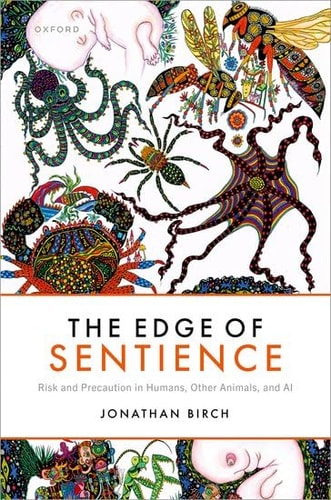
The Edge of Sentience: Risk and Precaution in Humans, Other Animals, and AI
0
0
As an Amazon Associate and affiliate partner, Menrva Books earns from qualifying purchases. Learn more
Author Description
This is an open access title available under the terms of a CC BY-NC-ND 4.0 International licence. It is free to read on the Oxford Academic platform and offered as a free PDF download from OUP and selected open access locations.Can octopuses feel pain and pleasure? What about crabs, shrimps, insects or spiders? How do we tell whether a person unresponsive after severe brain injury might be suffering? When does a fetus in the womb start to have conscious experiences? Could there even be rudimentary feelings in miniature models of the human brain, grown from human stem cells? And what about AI?These are questions about the edge of sentience, and they are subject to enormous, disorienting uncertainty. We desperately want certainty, but it is out of reach. The stakes are immense, and neglecting the risks can have terrible costs. We need to err on the side of caution, yet it's often far from clear what 'erring on the side of caution' should mean in practice. When are we going too far? When are we not doing enough?The Edge of Sentience presents a comprehensive precautionary framework designed to help us reach ethically sound, evidence-based decisions despite our uncertainty. The book is packed with specific, detailed proposals intended to generate discussion and debate. At no point, however, does it offer any magic tricks to make our uncertainty go away. Uncertainty is with us for the long term. We must manage our uncertainty by taking precautions that are proportionate to the risks. It's time to start debating what those steps should be.
Menrva's Summary
THE THESIS
How should society navigate the profound ethical risks associated with sentience in humans, non-human animals, and artificial intelligence when scientific certainty remains elusive? Jonathan Birch, a philosopher of science, constructs a precautionary framework to guide decision-making under conditions of deep uncertainty. By synthesizing biological, neurological, and ethical research, he argues that we must adopt proportionate risk-management strategies rather than waiting for definitive proof of consciousness.
THE SCOPE MAP
What You Will Find
- A systematic precautionary framework for ethical decision-making.
- Comparative analysis of sentience in invertebrates, brain-injured patients, and fetal development.
- Ethical evaluation of emerging technologies, including brain organoids and artificial intelligence.
Scope Limits
- The text does not provide definitive biological markers for consciousness.
- It avoids offering simple solutions to complex moral dilemmas.
THE AUTHORITY PERSPECTIVE
Experts recognize this work as a significant contribution to the philosophy of animal and machine ethics. Readers frequently note the academic rigor of the prose while appreciating the practical application of the proposed precautionary principles.
Page Count:
400
Publication Date:
2024-11-15
Publisher:
Oxford University Press
ISBN-10:
0192870424
ISBN-13:
9780192870421
Philosophy
Politics
Animal Rights
Ethics
Ethics & Morality
Consciousness & Thought
Consciousness Studies
Neuroscience
Community Tags
Similar Books