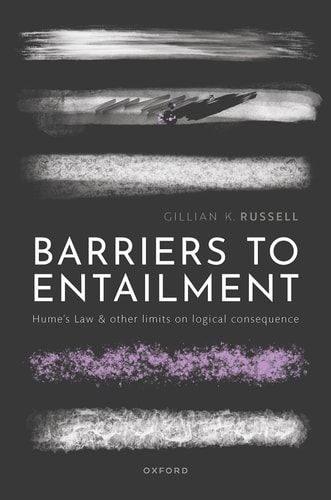
Barriers to Entailment: Hume's Law and Other Limits on Logical Consequence
0
0
As an Amazon Associate and affiliate partner, Menrva Books earns from qualifying purchases. Learn more
Author Description
A barrier to entailment exists if you can't get conclusions of a certain kind from premises of another. One of the most famous barriers in philosophy is Hume's Law, which says that you can't get normative conclusions from descriptive premises, or in slogan form: you can't get an ought from an is. This barrier is highly controversial, and many famous counterexamples were proposed in the last century. But there are other barriers which function almost as philosophical platitudes: no Universal conclusions from Particular premises, no Future conclusions from premises about the Past, and no claims that attribute Necessity from premises that merely tell us how things happen to be in the Actual world. Barriers to Entailment proposes a unified logical account of five barriers that have played important roles in philosophy, in the process showing how to diagnose proposed counterexamples and arguing that the case for Hume's Law is as strong as that for the platitudinous barriers.The first two parts of the book employ techniques from formal logic, but present them in an accessible way, suitable for any reader with some background in first-order model theory (of the kind that might be taught in a first class in logic). Gillian Russell introduces tense, modal, indexical, and deontic formal logics, but always avoids unneeded complexity. Each barrier is connected to broader philosophical topics: universality, time, necessity, context-sensitivity, and normativity. Russell brings out under-recognised connections between the domains and lays the groundwork for further work at the intersections.The last part of the book transposes the formal work to informal barrier theses in the philosophy of language, in the process doing new work on the concept of logical consequence, and providing new responses to proposed informal counterexamples to Hume's Law which employ hard-to-formalise tools from natural language, such as speech acts and thick normative expressions.
Menrva's Summary
THE THESIS
This book investigates the logical validity of 'barriers to entailment,' specifically questioning whether certain types of conclusions can be derived from disparate premises. Prof. Gillian K. Russell, a specialist in logic and philosophy of language, utilizes formal model theory to construct a unified framework for analyzing five distinct philosophical barriers. By examining the structural limitations of logical consequence, the author argues that the controversial 'Hume's Law'—the prohibition against deriving normative 'ought' statements from descriptive 'is' premises—possesses a logical robustness comparable to more widely accepted constraints like the impossibility of deriving universal conclusions from particular premises.
THE SCOPE MAP
What You Will Find
- A formal logical analysis of five major barriers to entailment including normativity, modality, and temporality.
- Applications of first-order model theory to philosophical problems.
- A synthesis of formal logic and informal philosophy of language regarding speech acts and thick normative expressions.
Scope Limits
- The text assumes the reader possesses a foundational background in first-order model theory.
- The analysis focuses primarily on logical structure rather than providing an exhaustive historical survey of every counterexample in the literature.
THE AUTHORITY PERSPECTIVE
Experts in the field recognize this work as a rigorous attempt to bridge the gap between formal logic and traditional philosophical debates. Readers frequently note that while the prose is accessible to those with a background in logic, the density of the formal arguments requires careful study to fully grasp the proposed unified account.
Page Count:
320
Publication Date:
2023-01-01
Publisher:
Oxford University Press
ISBN-10:
019287473X
ISBN-13:
9780192874733
Politics
Philosophy
Philosophy of
Ethics & Morality
Epistemology
Consciousness & Thought
Logic
Academic
Community Tags
Similar Books