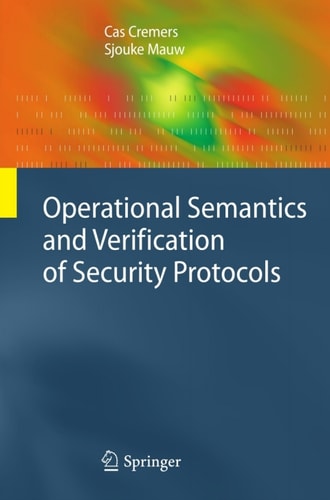
Operational Semantics and Verification of Security Protocols
0
0
As an Amazon Associate and affiliate partner, Menrva Books earns from qualifying purchases. Learn more
Author Description
Security protocols are widely used to ensure secure communications over insecure networks, such as the internet or airwaves. These protocols use strong cryptography to prevent intruders from reading or modifying the messages. However, using cryptography is not enough to ensure their correctness. Combined with their typical small size, which suggests that one could easily assess their correctness, this often results in incorrectly designed protocols. The authors present a methodology for formally describing security protocols and their environment. This methodology includes a model for describing protocols, their execution model, and the intruder model. The models are extended with a number of well-defined security properties, which capture the notions of correct protocols, and secrecy of data. The methodology can be used to prove that protocols satisfy these properties. Based on the model they have developed a tool set called Scyther that can automatically find attacks on security protocols or prove their correctness. In case studies they show the application of the methodology as well as the effectiveness of the analysis tool. The methodology’s strong mathematical basis, the strong separation of concerns in the model, and the accompanying tool set make it ideally suited both for researchers and graduate students of information security or formal methods and for advanced professionals designing critical security protocols.
Menrva's Summary
THE THESIS
This book presents a formal methodology for describing and verifying the security of communication protocols. The authors address the common pitfalls in designing security protocols, which often lead to incorrect implementations despite the use of strong cryptography. They introduce a comprehensive model encompassing protocol description, execution, and intruder behavior, extended with formal security properties like secrecy. This rigorous framework allows for the mathematical proof of protocol correctness, supported by the Scyther toolset for automated attack detection and verification.
THE SCOPE MAP
- A formal model for describing security protocols and their execution environments.
- An intruder model to represent potential attacks.
- Well-defined security properties to capture notions of correctness and secrecy.
- A methodology for proving that protocols satisfy these security properties.
- Case studies demonstrating the application of the methodology.
- The Scyther toolset for automated analysis of security protocols.
THE AUTHORITY PERSPECTIVE
The methodology's strong mathematical basis, the clear separation of concerns within its model, and the accompanying Scyther toolset position this work as highly valuable for both academic and professional audiences. It is designed to be suitable for researchers and graduate students in information security and formal methods, as well as for advanced professionals engaged in the design of critical security protocols. The book aims to provide a rigorous approach to ensuring the correctness and security of widely used communication protocols.
Page Count:
174
Publication Date:
2012-10-30
Publisher:
Springer Nature
ISBN-10:
3540786368
ISBN-13:
9783540786368
Science & Technology
Non-Fiction
Cryptography
Information Security
Formal Methods
Computer Science
Community Tags
Similar Books