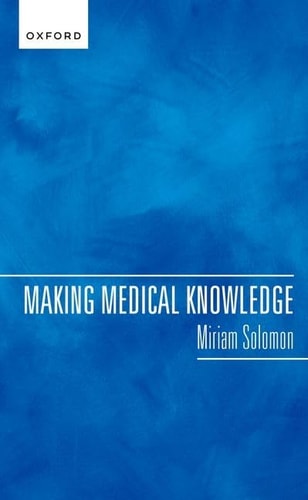
Making Medical Knowledge
0
0
As an Amazon Associate and affiliate partner, Menrva Books earns from qualifying purchases. Learn more
Author Description
How is medical knowledge made? New methods for research and clinical care have reshaped the practices of medical knowledge production over the last forty years. Consensus conferences, evidence-based medicine, translational medicine, and narrative medicine are among the most prominent new methods. Making Medical Knowledge explores their origins and aims, their epistemic strengths, and their epistemic weaknesses. Miriam Solomon argues that the familiar dichotomy between the art and the science of medicine is not adequate for understanding this plurality of methods. The book begins by tracing the development of medical consensus conferences, from their beginning at the United States' National Institutes of Health in 1977, to their widespread adoption in national and international contexts. It discusses consensus conferences as social epistemic institutions designed to embody democracy and achieve objectivity. Evidence-based medicine, which developed next, ranks expert consensus at the bottom of the evidence hierarchy, thus challenging the authority of consensus conferences. Evidence-based medicine has transformed both medical research and clinical medicine in many positive ways, but it has also been accused of creating an intellectual hegemony that has marginalized crucial stages of scientific research, particularly scientific discovery. Translational medicine is understood as a response to the shortfalls of both consensus conferences and evidence-based medicine. Narrative medicine is the most prominent recent development in the medical humanities. Its central claim is that attention to narrative is essential for patient care. Solomon argues that the differences between narrative medicine and the other methods have been exaggerated, and offers a pluralistic account of how the all the methods interact and sometimes conflict. The result is both practical and theoretical suggestions for how to improve medical knowledge and understand medical controversies.
Menrva's Summary
THE THESIS
How do contemporary methods of medical knowledge production shape the validity and application of clinical care? Miriam Solomon, a professor of philosophy, examines the evolution of medical research practices over the last four decades. She argues that the traditional binary between the art and science of medicine fails to account for the complex, pluralistic nature of modern medical epistemology.
THE SCOPE MAP
What You Will Find
- Analysis of consensus conferences, evidence-based medicine, translational medicine, and narrative medicine.
- Historical overview of the National Institutes of Health consensus development program starting in 1977.
- Evaluation of the epistemic strengths and weaknesses inherent in various medical research frameworks.
Scope Limits
- The text does not provide a comprehensive clinical manual for medical practitioners.
- It does not cover the entirety of medical history prior to the late 20th century.
THE AUTHORITY PERSPECTIVE
Experts in the philosophy of medicine recognize this work as a significant contribution to understanding the institutional structures of medical knowledge. Readers frequently note the academic density of the prose, which serves as a rigorous examination of how medical controversies are mediated.
Page Count:
288
Publication Date:
2022-10-21
Publisher:
Oxford University Press
ISBN-10:
019287229X
ISBN-13:
9780192872296
Epistemology
MEDICAL History
Sociology of Science
Medicine
Philosophy of
Community Tags
Other Editions(3)

Similar Books
Reader Comments
Share Your Thoughts
No comments yet. Be the first to share your thoughts!