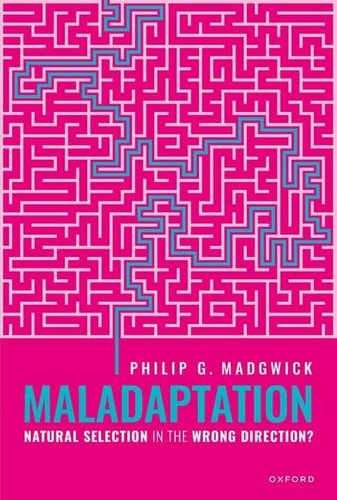
Maladaptation: Natural Selection in the Wrong Direction?
0
0
As an Amazon Associate and affiliate partner, Menrva Books earns from qualifying purchases. Learn more
Author Description
Charles Darwin presented the first scientific explanation of design through evolution by natural selection, where the environment furnishes individual organisms with adaptations that help them to survive and reproduce. This accessible book makes the case that natural selection can also do the exact opposite, favouring traits that directly harm an organism's ability to survive and reproduce. Such maladaptations contradict the received understanding of what natural selection 'does', but become explicable with an understanding of the genetics and ecology of evolution by natural selection.Drawing upon wide-ranging examples from across the diversity of life, the evidence for maladaptations is critically appraised to establish its possibility, reality and importance to the design of living things. A theory of maladaptation is developed, as a corrective for a long-standing error in evolutionary biology. Examples of maladaptation are evaluated to identify the challenges and successes in applying the concept to organismal traits. The deeper causes and consequences of maladaptation are discussed to understand its far-reaching impact on the evolution of life on Earth - and beyond. Overall, the book persuasively argues that maladaptation is a paragon of the changes to evolutionary theory that are needed to understand the population biology of natural selection.Maladaptation is written to be suitable for students taking courses in evolution, ecology and genetics, as well as professional researchers in these fields. Its accessible style will also appeal to a broader interdisciplinary audience, including any inquisitive reader with a general interest in science and the natural world.
Menrva's Summary
THE THESIS
This book investigates the phenomenon of maladaptation, challenging the conventional view that natural selection exclusively favors traits that enhance survival and reproduction. Philip G. Madgwick, drawing on his background in evolutionary biology, argues that natural selection can frequently favor traits that are actively detrimental to an organism. By integrating genetics and ecology, the author constructs a theoretical framework to explain why these counter-intuitive traits persist and how they function within the broader context of evolutionary design.
THE SCOPE MAP
What You Will Find
- A comprehensive theory of maladaptation as a corrective to traditional evolutionary models.
- Analysis of diverse biological examples across various species to demonstrate the reality of harmful traits.
- Discussion on the deeper causes and long-term consequences of maladaptation for life on Earth.
Scope Limits
- The text focuses primarily on biological and genetic mechanisms, omitting extensive philosophical or theological debates regarding evolutionary design.
- It does not provide an exhaustive catalog of every known maladaptive trait in existence.
THE AUTHORITY PERSPECTIVE
Experts and students in the fields of ecology and genetics view this work as a significant contribution to the ongoing refinement of evolutionary theory. Readers frequently note the clarity of the prose, which makes complex genetic concepts accessible to both professional researchers and the general public.
Page Count:
256
Publication Date:
2024-10-04
Publisher:
Oxford University Press
ISBN-10:
0192870467
ISBN-13:
9780192870469
Science
Natural History
Evolutionary Biology
Ecology
Genetics
Evolution
Community Tags
Similar Books