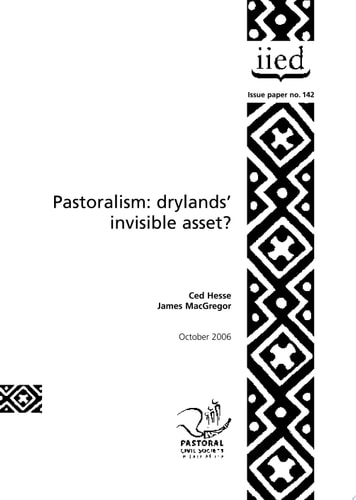
Pastoralism Drylands' Invisible Asset? : Developing a Framework for Assessing the Value of Pastoralism in East Africa
0
0
As an Amazon Associate and affiliate partner, Menrva Books earns from qualifying purchases. Learn more
Author Description
Many policy makers in East Africa have preconceptions about the value of pastoralism as a land-use system believing it to be economically inefficient and environmentally destructive. Yet, this is not evidence-based. Not only is there no consensus on what is a dynamic economic model of pastoralism, no mechanisms exist to inform government decision-making of its comparative advantages over alternative land uses. This paper argues that pastoralism does make a significant contribution to society and that, with better understanding, planning and data collection, its value can be demonstrated. The paper presents a preliminary framework for assessing the benefits of pastoralism that goes beyond conventional criteria relating to livestock and their by-products. While the paper focuses on East Africa, much of the analysis is applicable to pastoral systems in other regions of Africa.
Menrva's Summary
THE THESIS
This paper challenges prevailing negative perceptions of pastoralism in East Africa by proposing a framework to quantify its often-overlooked economic and societal value. The authors, Ced Hesse and James Murdoch Macgregor, address the common policy preconceptions that pastoralism is economically inefficient and environmentally destructive, arguing that these views lack an evidence base. They highlight the absence of a clear economic model for pastoralism and mechanisms to inform government decision-making regarding its comparative advantages. The paper asserts that pastoralism significantly contributes to society and that improved understanding, planning, and data collection can demonstrate its true value.
THE SCOPE MAP
- A framework for assessing the benefits of pastoralism beyond conventional livestock and by-product metrics.
- Analysis of the economic inefficiencies and environmental destruction often attributed to pastoralism.
- Discussion on the lack of consensus regarding dynamic economic models of pastoralism.
- Examination of mechanisms to inform government decision-making on land-use alternatives.
- Application of the framework to East African pastoral systems, with relevance to other African regions.
THE AUTHORITY PERSPECTIVE
This paper addresses a critical gap in policy-making by providing a structured approach to valuing pastoralism, a system often misunderstood and undervalued in East Africa. By moving beyond traditional economic indicators, the authors aim to equip policymakers with data-driven insights to better understand the comparative advantages of pastoral land use. The proposed framework is intended to foster more informed decisions that recognize the significant societal contributions of pastoral communities.
Page Count:
40
Publication Date:
2006-01-01
Publisher:
IIED
ISBN-10:
1843696371
ISBN-13:
9781843696377
Economics
Politics
Non-Fiction
Agriculture
Community Tags
Similar Books